In this article
- How Long Does a Bathroom Remodel Really Take?
- Quick Answer: Bathroom Remodel Timeline by Project Size
- Pre-Construction Phase (2-6 Weeks Before Demolition)
- Design and Material Selection: 1-3 Weeks
- NJ Permit Application and Approval: 1-4 Weeks
- Material Ordering and Lead Times: 2-6 Weeks
- Phase-by-Phase Construction Timeline
- Week 1: Demolition and Rough-In
- Week 2: Waterproofing and Substrate
- Weeks 2-3: Tile Work
- Weeks 3-4: Fixtures and Finishes
- Weeks 4-5: Final Details
- Small Bathroom vs Master Bath Timeline Comparison
- What Causes Bathroom Remodel Delays
- NJ Permit Delays
- Backordered Materials
- Hidden Problems Discovered During Demo
- Change Orders Mid-Project
- Subcontractor Scheduling
- Weather and Inspection Scheduling
- NJ Permit Timelines by Municipality
- How to Keep Your Bathroom Remodel on Schedule
- Make All Material Decisions Before Demo
- Order Long-Lead Items Immediately
- Hire a Contractor Who Manages the Schedule
- Budget for Contingencies
- Be Available and Avoid Scope Creep
- Choose a Contractor with Local Permit Experience
- Your Bathroom Remodel Starts with a Realistic Timeline
How Long Does a Bathroom Remodel Really Take?#
It depends on what you are doing to the room. A powder room refresh where we swap a vanity, install a new faucet, and repaint takes one to two weeks. A full master bathroom gut renovation with layout changes, custom tile work, and frameless glass takes eight to twelve weeks from demolition to your first shower.
Most homeowners in Lawrence, Princeton, Hamilton, and across Mercer County underestimate the total calendar time because they start counting at demolition day. But the real timeline begins weeks earlier during design, material ordering, and NJ permit processing. That pre-construction phase is invisible to most people — and it is where most schedule surprises come from.
We have built hundreds of bathrooms across Central New Jersey. This guide breaks down every phase in detail so you know exactly what to expect, when to expect it, and what drives the timeline for your specific project.
---
Quick Answer: Bathroom Remodel Timeline by Project Size#
Before we get into the phase-by-phase breakdown, here is the big picture:
| Project Type | Construction Time | Total Time (Including Pre-Construction) |
|---|---|---|
| Powder room refresh (vanity, faucet, paint, mirror) | 1-2 weeks | 3-5 weeks |
| Standard bathroom remodel (full tile, new fixtures, same layout) | 3-5 weeks | 6-10 weeks |
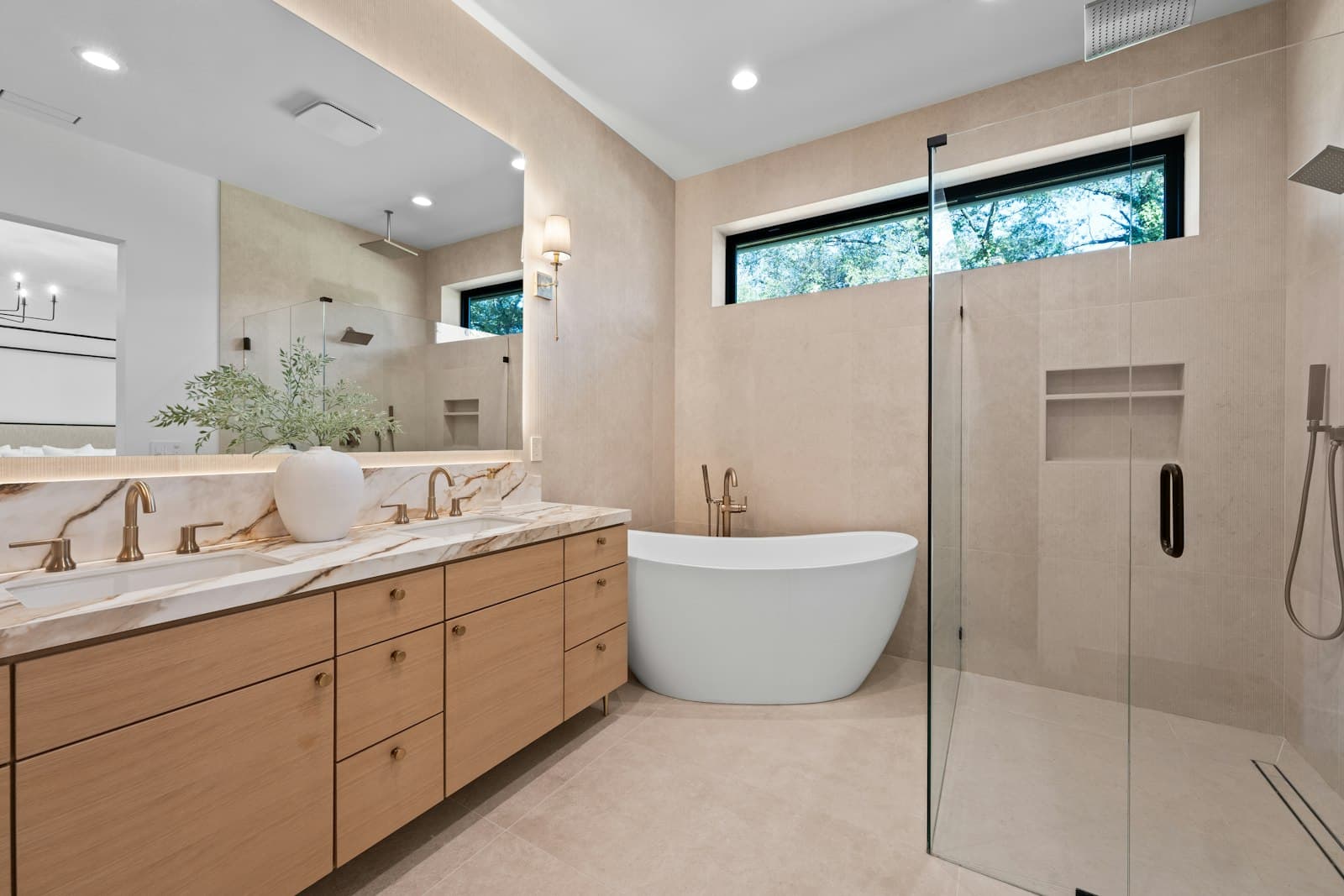
| Master bath remodel (large space, custom tile, frameless glass) | 5-8 weeks | 8-14 weeks |
| Master bath with layout changes (moving plumbing, walls, expanding) | 8-12 weeks | 12-18 weeks |
The difference between construction time and total time is the pre-construction lead time for design, permits, and material ordering. Every project has both. Let us walk through each phase.
---
Pre-Construction Phase (2-6 Weeks Before Demolition)#
This is the phase that determines whether your bathroom remodel stays on schedule or falls behind before a single tile is removed. Every decision you lock in now prevents a delay during construction.
Design and Material Selection: 1-3 Weeks#
The design phase covers your bathroom layout, material selections, and scope of work. For a powder room refresh, this takes a few days. For a master bathroom with a custom shower, freestanding tub, and heated floors, plan on two to three weeks.
During this phase, your contractor will: - Measure and document the existing bathroom - Discuss your goals, budget, and must-haves - Present layout options if the floor plan is changing - Walk you through material choices — tile, vanity, countertop, fixtures, shower system - Create a detailed scope of work with a line-item estimate
Material selection is where many homeowners lose time without realizing it. You are choosing tile, grout color, vanity, countertop, faucets, shower fixtures, toilet, mirrors, lighting, and hardware — fifteen to twenty decisions that each affect the next.
Pro tip: Pick your tile first. Tile drives the color palette for everything else. If you try to work backwards from the vanity or paint, you will end up stuck on tile selection for weeks.
NJ Permit Application and Approval: 1-4 Weeks#
Any bathroom remodel that involves plumbing changes, electrical work, or structural modifications requires permits in New Jersey. For a standard bathroom remodel, you will typically need: - A building permit for general construction - A plumbing sub-permit for any supply or drain line work - An electrical sub-permit for lighting, exhaust fans, and GFCI circuits
Your contractor handles the permit application, but processing time is entirely in your municipality's hands. In Mercer County, approval times range from five business days in Ewing to two to three weeks in Princeton. We cover specific municipality timelines later in this guide.
If your bathroom remodel is purely cosmetic — replacing a vanity in the same footprint, painting, swapping a mirror and light fixture — permits are generally not required. But the moment plumbing moves or electrical circuits change, you need permits. Do not skip this. NJ inspectors have authority to stop unpermitted work and require you to tear it out.
Material Ordering and Lead Times: 2-6 Weeks#
This is where the calendar stretches. Once materials are selected, they need to be ordered and delivered. Lead times vary widely:
- Stock tile from a local distributor: 1-2 weeks
- Specialty or imported tile (from suppliers like Floor & Decor, TileBar, or direct from manufacturers): 3-6 weeks
- Custom vanities (semi-custom from manufacturers like James Martin, Fairmont, or RTA): 3-6 weeks
- Stock vanities (from Home Depot, Lowe's, or Wayfair): 1-2 weeks
- Frameless shower glass (custom measured and fabricated): 2-4 weeks after measurement — and measurement cannot happen until the tile is installed
- Plumbing fixtures (faucets, shower valves, showerheads): 1-2 weeks for most brands, 4-6 weeks for luxury brands like Brizo or Waterworks
- Countertops (quartz or granite): 1-2 weeks after templating
An experienced contractor orders long-lead items as early as possible — often before permits are approved — so the manufacturing lead time runs in parallel with permit processing. This is one of the biggest differences between a contractor who manages timelines well and one who does not.
The item that surprises people most: Frameless shower glass. It cannot be measured until the tile is finished, and fabrication takes two to four weeks after measurement. This means there is a built-in gap near the end of the project where you are waiting for glass. We schedule this measurement visit the day tile work completes so we do not lose a single day.
---
Phase-by-Phase Construction Timeline#
Here is what happens week by week once construction begins. This timeline is for a standard to master bathroom remodel. Smaller projects compress the schedule; larger projects with layout changes extend it.
Week 1: Demolition and Rough-In#
Day 1-2: Demolition
Everything comes out — existing tile, vanity, toilet, shower or tub, drywall behind tile, and flooring down to subfloor. For a full gut, demo takes one to two days including debris removal. Our crews use containment barriers and floor protection to keep dust out of the rest of your home. Your bathroom should be stripped to studs and subfloor by end of day two.
Day 2-3: Plumbing Rough-In
Once the space is gutted, the plumber comes in to move or add supply lines, relocate drain lines (if the layout is changing), set the shower valve at the correct height, install supply and waste lines for the toilet and vanity, and set the shower drain. If your layout stays the same, plumbing rough-in takes one day. If drains are moving — which means cutting into the subfloor or slab — plan on two to three days.
Day 3-4: Electrical Rough-In
The electrician runs new circuits — dedicated 20-amp GFCI circuit (NJ code requirement), wiring for vanity lights, recessed lights, exhaust fan, and heated floor wiring if you are adding radiant heat. Electrical rough-in takes one day for a standard bathroom, two days if heated floors or significant circuit additions are involved.
Day 4-5: NJ Rough-In Inspection
Before anything gets covered up, the municipality sends an inspector to verify the plumbing and electrical rough-in meet NJ code. This is a required inspection — the wall and floor substrates cannot be installed until it passes.
In most Mercer County towns, inspections can be scheduled within two to five business days. During peak construction season (spring and summer), it can stretch to a week. Your contractor should schedule this inspection the moment rough-in work begins so there is minimal dead time waiting.
If the inspection fails — which is uncommon with an experienced contractor but does happen — corrections need to be made and the inspector returns. This can add two to five days to the schedule.
Week 2: Waterproofing and Substrate#
This is the most important and most overlooked phase of a bathroom remodel. Waterproofing is what separates a bathroom that lasts twenty years from one that develops mold and water damage within five.
Shower Pan and Waterproofing System: 2-3 Days
We use engineered waterproofing systems — either Schluter DITRA and Kerdi or Laticrete Hydro Ban — rather than old-school hot-mop or liner methods. Every square inch of the shower area gets a bonded waterproof membrane, including seams, corners, niches, and curbs. We build a mortar bed sloped to the drain, apply the membrane system, and flood-test the pan before moving to tile.
Cement Board and Substrate: 1-2 Days
Cement board goes up on all wall surfaces receiving tile — standard drywall cannot be used in wet areas. The floor gets cement board or an uncoupling membrane over the plywood subfloor. Non-tiled walls get moisture-resistant drywall (purple board), which we tape, mud, and finish so they are paint-ready by the time tile work begins.
Weeks 2-3: Tile Work#
Tile is the longest single phase of a bathroom remodel and the one that most directly affects how the finished room looks and feels. Rushing tile work shows. We do not rush it.
Floor Tile: 2-3 Days
Floor tile goes down first. The layout is planned so cuts are symmetrical and the pattern reads correctly from the doorway. Large-format tile (12x24 or larger) requires a perfectly level subfloor — our crews check with a laser level and self-level when needed before setting the first tile.
Shower and Wall Tile: 3-7 Days
This is where the timeline varies most. A simple subway tile shower with one accent stripe takes three to four days. A fully custom shower with large-format porcelain, mosaic floor, waterfall niche, and bench takes five to seven days.
What affects tile time: tile size (larger tiles need more precise leveling), pattern complexity (herringbone takes significantly longer than running bond), number of transitions between tile types, and niche and bench details that require work on multiple planes.
Grout and Sealing: 1-2 Days
After tile is set and cured (minimum 24 hours), grout goes in. After grouting, another 24 to 48 hours of cure time before sealing. Grout sealer protects against staining and moisture penetration.
Weeks 3-4: Fixtures and Finishes#
With tile complete, the bathroom starts looking like a bathroom. This is the phase where all the pieces come together.
Vanity and Countertop Installation: 1-2 Days
The vanity is set and leveled, plumbing connections are roughed in from below, and the countertop is installed. Prefabricated vanities with integrated tops go in as one piece. Furniture-style vanities with separate stone countertops require templating after install and one to two weeks of fabrication lead time.
Toilet Installation: Half Day
The toilet installs quickly — a few hours including the wax ring, supply line, and bolt-down. We set the toilet after floor tile is installed and grouted.
Shower Glass: 1-3 Weeks Lead Time, 1 Day Installation
If your shower has frameless glass (door and panel, or a fixed panel), here is the sequence: 1. Tile must be 100% complete and grouted 2. The glass company comes for a field measurement visit (they measure the actual opening, not the plans) 3. Glass is fabricated to the exact measurements — this takes two to four weeks 4. Glass is installed in one day
This is the single biggest scheduling gap in most bathroom remodels. The glass company cannot measure until tile is done, and fabrication takes weeks. An experienced contractor schedules the measurement visit the same day the last tile grout is sealed to compress this gap as much as possible.
Frameless glass alternative: If you want to avoid the wait, a semi-frameless glass door or a framed pivot door can be ordered from stock sizes and installed within a week of tile completion. The look is different, but the timeline savings can be meaningful.
Mirrors, Accessories, and Hardware: 1 Day
Mirrors get mounted, towel bars and hooks are installed, toilet paper holder goes up, robe hooks, shower shelves — all the finishing details. This also includes installing switch plates, outlet covers, and any decorative hardware.
Weeks 4-5: Final Details#
Paint and Trim: 1-2 Days
All non-tiled wall surfaces get painted. Door and window trim is installed or refinished. Baseboard goes in around the perimeter (we typically use PVC or composite baseboards in bathrooms for moisture resistance). Caulk lines are run at every transition — where tile meets the tub, where the vanity meets the wall, where the floor meets the baseboard.
Final Plumbing Connections: 1 Day
The plumber returns to make final connections: - Faucet installation on the vanity - Showerhead, hand shower, and any body sprays - Toilet supply line connection - P-trap and drain connections under the vanity - Testing every fixture for leaks and proper operation
Final Electrical: Half Day
The electrician installs: - Vanity light fixtures - Recessed light trim - Exhaust fan trim - GFCI outlets (NJ code requires GFCI protection for all bathroom outlets) - Switch plates and dimmer switches - Heated floor thermostat if applicable
Final NJ Inspection: 1-3 Days Wait
The municipality sends an inspector for the final inspection covering plumbing (connections, leaks, venting), electrical (GFCI protection, circuit sizing, exhaust fan), and building (structural integrity, code compliance). Some municipalities combine these into one visit; others require separate inspections on separate days.
Cleanup and Walkthrough: 1 Day
The crew does a detailed cleanup, then we do a formal walkthrough with you to inspect every detail — tile, grout, fixtures, glass, paint, hardware, lighting, caulk. Any punch list items are noted and addressed before we consider the project complete.
---
Small Bathroom vs Master Bath Timeline Comparison#
Here is a side-by-side comparison of the two most common bathroom remodel scopes:
| Phase | Small/Standard Bath | Master Bath |
|---|---|---|
| Design and material selection | 1-2 weeks | 2-3 weeks |
| NJ permits | 1-3 weeks | 1-4 weeks |
| Material ordering | 2-4 weeks | 3-6 weeks |
| Demolition | 1-2 days | 2-3 days |
| Plumbing rough-in | 1 day | 1-3 days |
| Electrical rough-in | 1 day | 1-2 days |
| Rough-in inspection | 2-5 day wait | 2-5 day wait |
| Waterproofing and substrate | 3-4 days | 4-6 days |
| Floor tile | 1-2 days | 2-3 days |
| Shower and wall tile | 2-4 days | 4-7 days |
| Grout and sealing | 1 day | 1-2 days |
| Vanity and countertop | 1 day | 1-2 days |
| Toilet | Half day | Half day |
| Shower glass lead time | 2-3 weeks | 2-4 weeks |
| Shower glass install | 1 day | 1 day |
| Paint, trim, accessories | 1 day | 1-2 days |
| Final plumbing and electrical | 1 day | 1-2 days |
| Final NJ inspection | 2-5 day wait | 2-5 day wait |
| Cleanup and walkthrough | Half day | 1 day |
| Total construction time | 3-5 weeks | 5-8 weeks |
| Total project time | 6-10 weeks | 10-16 weeks |
The biggest time differences are tile work (more surface area, more complex designs) and pre-construction lead times (higher-end materials with longer lead times).
---
What Causes Bathroom Remodel Delays#
We believe in being honest about this. Here is every major cause of delay we have seen across hundreds of bathroom projects in New Jersey.
NJ Permit Delays#
Permit processing times are outside your contractor's control. Some municipalities in Mercer County process residential bathroom permits in a week. Others take three weeks or more. During peak season (March through October), processing times increase across the board. Your contractor should submit permits as early as possible and follow up proactively.
Backordered Materials#
Specific items that frequently back-order: specialty tile (imported porcelain, handmade ceramic, natural stone), custom vanities, frameless shower glass (fabricators in the tri-state area get backed up during spring and summer), and luxury plumbing fixtures from brands like Brizo or Waterworks. We do not start demo until critical materials are in our warehouse or confirmed for delivery within the project window.
Hidden Problems Discovered During Demo#
When we open up walls and floors, we sometimes find water damage and rot from old leaks, mold behind tile and inside wall cavities, corroded galvanized plumbing, inadequate subfloor, and asbestos in floor tiles or pipe insulation (common in pre-1980 homes). A good contractor inspects what is accessible before providing an estimate, but some problems only reveal themselves during demolition. Budget a 10-15 percent contingency. In older homes in Princeton, Hopewell, and Ewing, we budget closer to 15-20 percent.
Change Orders Mid-Project#
Every time a material selection changes after construction starts, the schedule slips. Changing tile after demo means waiting for new tile to be ordered and delivered. Changing a vanity after plumbing rough-in may mean the plumber needs to return and adjust positions. Make all decisions during design and commit to them.
Subcontractor Scheduling#
A bathroom remodel involves multiple trades in sequence — plumber, electrician, tile installer, glass company, painter. If one trade runs long or has a scheduling conflict, every subsequent trade gets pushed. Experienced contractors build buffer days into the schedule and maintain reliable subcontractor relationships.
Weather and Inspection Scheduling#
Most bathroom work happens indoors, so weather is rarely a factor unless the project involves adding a window or venting through an exterior wall. Municipal inspectors operate on their own schedules — most inspections book within two to five business days, but during peak season, wait times stretch longer. There are two required inspections (rough-in and final), and delays at either point ripple through the schedule.
---
NJ Permit Timelines by Municipality#
If you are planning a bathroom remodel in Mercer County, here are the typical permit processing times we experience:
| Municipality | Typical Approval Time | Notes |
|---|---|---|
| Lawrence Township | 5-10 business days | Efficient building department. Standard bathroom permits process quickly. Located at the municipal building on US Route 1. |
| Princeton | 10-20 business days | Thorough review process. Historic district projects require additional HPC review that can add 2-4 weeks. |
| Hamilton Township | 5-10 business days | High volume but efficient processing. Staff is generally responsive to questions during review. |
| Ewing Township | 5-8 business days | Typically the fastest turnaround in the county for standard residential bathroom permits. |
| Hopewell Township | 7-14 business days | Strict zoning and building requirements. Rural zone projects may require additional review. |
| West Windsor | 7-14 business days | Growing municipality with significant development activity. HOA approval may be needed in planned communities. |
These are typical timelines based on our experience. Actual processing times vary depending on department workload, completeness of the application, and the complexity of the project. Your contractor should submit a complete application with all required documentation to avoid delays from resubmission.
---
How to Keep Your Bathroom Remodel on Schedule#
Based on everything we have seen go right and wrong across hundreds of projects, here are the most effective things you can do to keep your bathroom remodel on time.
Make All Material Decisions Before Demo#
This is the single most important thing you can do. Every tile, every fixture, every piece of hardware should be selected, ordered, and confirmed for delivery before demolition day. Changing your mind after construction starts is the most common homeowner-driven cause of delay.
Order Long-Lead Items Immediately#
Once materials are selected, place orders the same week. Do not wait for permits to be approved — let the material lead times run in parallel with permit processing. This alone can save three to six weeks on the total project timeline.
Hire a Contractor Who Manages the Schedule#
Your contractor should provide a detailed week-by-week project schedule before construction begins, proactively schedule inspections, coordinate subcontractor arrivals, and track material deliveries. If your contractor cannot tell you exactly what is happening each week of your project, that is a red flag.
Budget for Contingencies#
Set aside 10-15 percent of your total budget for unexpected issues discovered during demolition. Having the contingency budget prevents delays caused by needing to stop work while you figure out how to pay for an unexpected repair.
Be Available and Avoid Scope Creep#
During construction, your contractor will need quick decisions on details — grout color, tile direction, trim profiles. Being responsive (hours, not days) keeps the crew productive. And resist the urge to add work mid-project. "While we have the walls open, can we also..." is the sentence that extends more bathroom remodel timelines than any other.
Choose a Contractor with Local Permit Experience#
A contractor who regularly works in your municipality knows the building department, the inspectors, and the local code interpretations. This local knowledge saves real time. We work in Lawrence, Princeton, Hamilton, Ewing, West Windsor, Hopewell, and Pennington regularly and know each building department well.
---
Your Bathroom Remodel Starts with a Realistic Timeline#
Every bathroom remodel we build at The 5th Wall starts with a detailed project schedule — not a vague range, but a week-by-week plan tailored to your specific bathroom, scope, and material selections. We tell you exactly what is happening each week, what drives the timeline, and what we do to keep things on track.
We are a licensed NJ contractor with deep experience building bathrooms across every Mercer County municipality. We handle design, permits, construction, and final inspection — and we manage the schedule so you do not have to.
For detailed pricing on your bathroom project, read our bathroom remodel cost guide for NJ. If you are still exploring ideas, check out our bathroom renovation ideas guide. Wondering whether to do the kitchen or bathroom first? See our kitchen vs bathroom remodel comparison. For a look at kitchen timelines, read our kitchen remodel timeline guide. And for everything you need to know about NJ permits, visit our NJ renovation permits guide.
Learn more about our bathroom remodeling services and what the process looks like from start to finish.
Call us at (609) 954-3659 or fill out our contact form to schedule a free in-home consultation and get a realistic timeline for your bathroom remodel.
Written by
The5thwall
Published April 13, 2026 · 14 min read
The5thwall is a father-and-son licensed NJ contractor based in Mercer County. Beyond the Blueprint is our journal — field-tested insights from two decades of renovation work across Central New Jersey.