In this article
- Your Basement Bar Is the Room Everyone Remembers
- Bar Types: Wet Bar vs. Dry Bar vs. Everything Else
- Dry Bar (No Plumbing)
- Wet Bar (With Plumbing)
- Full Bar (Kitchen-Grade)
- 30+ Basement Bar Ideas by Style
- Budget-Friendly Bars ($2,000-$5,000)
- Mid-Range Bars ($5,000-$15,000)
- Premium Bars ($15,000-$30,000+)
- Specialty Designs
- Layout Planning: Where to Put the Bar
- Against a Wall (Most Common)
- Peninsula (Popular)
- Island (Premium)
- Under the Stairs
- Cabinet and Countertop Options
- Cabinets
- Countertops
- Bar Countertop Dimensions
- Lighting: The Make-or-Break Detail
- Over-Bar Lighting
- Accent Lighting
- What to Avoid
- Plumbing Requirements for NJ Basement Bars
- Wet Bar Plumbing Basics
- NJ Permit Requirements
- Cost of Basement Bar Plumbing
- What to Know Before You Build
- Ceiling Height Matters
- Ventilation
- Moisture
- Floor Drain Access
- Ready to Build Your Basement Bar?
Your Basement Bar Is the Room Everyone Remembers#
A basement bar is the single feature that transforms a finished basement from a nice bonus room into the place everyone wants to be. When you tell people you finished your basement, the first question is always "Did you put a bar in?"
In NJ, where entertaining is a way of life and basements are standard, a well-designed bar turns dead square footage into the best room in the house. This guide covers 30+ basement bar concepts organized by style, budget, and complexity — from a $2,000 dry bar you can build in a weekend corner to a $30,000+ custom wet bar with draft beer and seating for ten.
Bar Types: Wet Bar vs. Dry Bar vs. Everything Else#
Dry Bar (No Plumbing)#
A dry bar has no sink, no running water, no drain. It is a countertop with storage, a mini-fridge or beverage cooler, and display shelving. Simple to build and does not require plumbing permits.
Cost range: $2,000-$8,000 Permit required: Typically no (unless electrical work is involved) Best for: Budget builds, basements where plumbing access is difficult or expensive, and homeowners who just want a dedicated drink-making station
Wet Bar (With Plumbing)#
A wet bar includes a sink with running water and a drain. This requires hot and cold water supply lines, a drain line, and (in basements below the sewer line) a sewage ejector or pump-up system. Wet bars require plumbing permits in NJ.
Cost range: $5,000-$20,000 Permit required: Yes (plumbing permit minimum) Best for: Serious entertaining, anyone who wants to wash glasses and prep without going upstairs, and bar designs that include a dishwasher
Full Bar (Kitchen-Grade)#
A full bar includes a sink, dishwasher, full-size refrigerator or kegerator, ice maker, and sometimes a second prep sink. This is essentially a small kitchen dedicated to beverage service.
Cost range: $15,000-$30,000+ Permits required: Yes (plumbing, electrical, possibly mechanical) Best for: Homeowners who entertain frequently, want draft beer capability, or are building the basement as a true entertainment suite
30+ Basement Bar Ideas by Style#
Budget-Friendly Bars ($2,000-$5,000)#
1. The Cart Bar — A rolling bar cart or converted furniture piece positioned against a wall with a beverage cooler underneath. Not built-in but functional and stylish. $500-$1,500.
2. The Floating Shelf Bar — Open shelving mounted on the wall above a simple base cabinet with a countertop. Display bottles on shelves, store glasses and supplies in the cabinet. $1,500-$3,000.
3. The Repurposed Dresser Bar — A vintage dresser or buffet converted into a bar. Top surface becomes the serving area, drawers store supplies, and a mini-fridge sits beside it. $800-$2,500 depending on the furniture piece.
4. The Corner Dry Bar — Built-in L-shaped counter in a basement corner with base cabinets, a countertop, and a beverage cooler. Compact footprint (4x4 to 5x5 feet). $2,500-$5,000.
5. The Open Shelf Station — Floor-to-ceiling open shelving with a butcher block countertop. Wine bottles, glasses, spirits displayed openly. Industrial-modern aesthetic. $1,500-$3,500.
6. The Under-Stairs Bar — Uses the dead space under the basement stairs for a built-in bar niche. Custom shelving and a narrow countertop turn unused space into a surprisingly functional bar. $2,000-$4,500.
Mid-Range Bars ($5,000-$15,000)#
7. The Classic Wet Bar — Straight or L-shaped counter with sink, base cabinets, upper cabinets or open shelving, beverage cooler, and bar countertop. The most popular basement bar configuration. $5,000-$10,000.
8. The Rustic Pub Bar — Reclaimed wood bar top, exposed brick or stone accent wall, Edison bulb pendant lighting, and pub-style stools. Warm, inviting, and built for long conversations. $6,000-$12,000.
9. The Sports Bar — Bar counter facing a wall-mounted TV (65-inch minimum for a sports bar feel). Dedicated lighting that does not reflect on the screen. Counter depth of 18-24 inches with comfortable stools. $5,000-$10,000 (not including TV and audio).
10. The Wine Bar — Built-in wine rack or wine cooler (dual zone, 30-50 bottle capacity), wine glass stemware rack mounted under upper cabinets, quartzite or marble countertop, and accent lighting inside the wine display. $7,000-$15,000.
11. The Peninsula Bar — Bar extends out from the wall, creating a peninsula that separates the bar area from the rest of the basement. Provides seating on the open side (typically 3-4 stools) and working space behind. $7,000-$12,000.
12. The Built-In Banquette Bar — Bar counter with a built-in booth or banquette on the guest side instead of stools. Creates a lounge-like experience. The booth provides hidden storage under the seats. $8,000-$14,000.
13. The Tiki Bar — Bamboo or rattan facing on the bar front, thatched or wood-paneled soffit above, tropical pendant lights, and a fun aesthetic that says vacation. Surprisingly popular in NJ basements. $6,000-$12,000.
14. The Modern Minimalist Bar — Flat-panel cabinets, quartz countertop in white or gray, integrated LED lighting under the counter and in the backsplash area, and no visible hardware. Clean, contemporary, and timeless. $8,000-$15,000.
15. The Coffee and Cocktail Bar — Dual-purpose station with an espresso machine nook, coffee supplies storage, and a separate cocktail prep area. Used daily for morning coffee and transitions to bar duty in the evening. $6,000-$12,000.
Premium Bars ($15,000-$30,000+)#
16. The Full Wet Bar With Draft System — Professional-grade wet bar with kegerator, draft tower (2-4 taps), commercial bar sink, glass rinser, ice maker, dishwasher, and stone countertop. Built-in glycol line cooling if taps are more than 5 feet from the kegerator. $18,000-$30,000+.
17. The Cocktail Lounge — Full-length bar (8-12 feet) with seating for 5-8, ambient lighting (no overhead fluorescents — pendant lights and LED accents only), upholstered bar stools, and a back bar with illuminated shelving displaying spirits. $15,000-$25,000.
18. The Home Pub — Complete pub environment with bar counter, pub-height tables, dart board area, memorabilia wall, beer taps, and dedicated lighting zones. Some NJ homeowners add a partition wall to create a true room-within-a-room feel. $18,000-$30,000.
19. The Speakeasy — Hidden bar behind a bookcase door or concealed panel. Dark wood, leather stools, brass fixtures, low lighting, and a private-club atmosphere. The bookcase door alone runs $3,000-$8,000 from specialty manufacturers. $20,000-$35,000 total.
20. The Wine Cellar Bar — Climate-controlled wine storage (insulated walls, dedicated cooling unit) combined with a tasting bar. Stone or brick walls, vaulted or beamed ceiling treatment, and professional wine racking. $20,000-$40,000 including climate control.
21. The Entertainment Hub Bar — Bar integrated with a home theater or gaming area. Sound-dampened construction (see basement ceiling options), bar counter with sightlines to the screen, under-counter beverage service so no one blocks the view, and acoustic treatment. $20,000-$35,000.
22. The Craft Beer Bar — Centered around a 4-6 tap draft system with a built-in kegerator, glass rinser, and drain. Chalkboard or digital tap list display. Growler fill station. Designed for the serious homebrewer or craft beer enthusiast. $15,000-$25,000.
Specialty Designs#
23. The Outdoor-Indoor Bar — Bar counter built into the wall separating the basement from an egress window well or walkout. Window opens to create an indoor-outdoor serving window. Works beautifully in walkout basements. $10,000-$20,000.
24. The Island Bar — Freestanding bar island in the center of the basement, not against any wall. Provides 360-degree access and seating on all sides. Requires adequate basement square footage (at least 400+ sq ft dedicated to the bar area). $12,000-$25,000.
25. The Curved Bar — Curved bar counter (requires custom fabrication for the countertop) creates a more organic, social atmosphere than a straight bar. Seating curves inward, encouraging conversation. Premium option due to custom countertop fabrication. $15,000-$30,000.
26. The Murphy Bar — Wall-mounted bar that folds down when needed and folds up flat against the wall when not in use. Perfect for basements where the bar area also serves another function (home gym, playroom). $3,000-$8,000 for a custom-built murphy bar.
27. The Galley Bar — Two parallel counters creating a narrow working bar. One side for prep and storage, the other for serving and guest seating. Efficient in narrow basements. $10,000-$18,000.
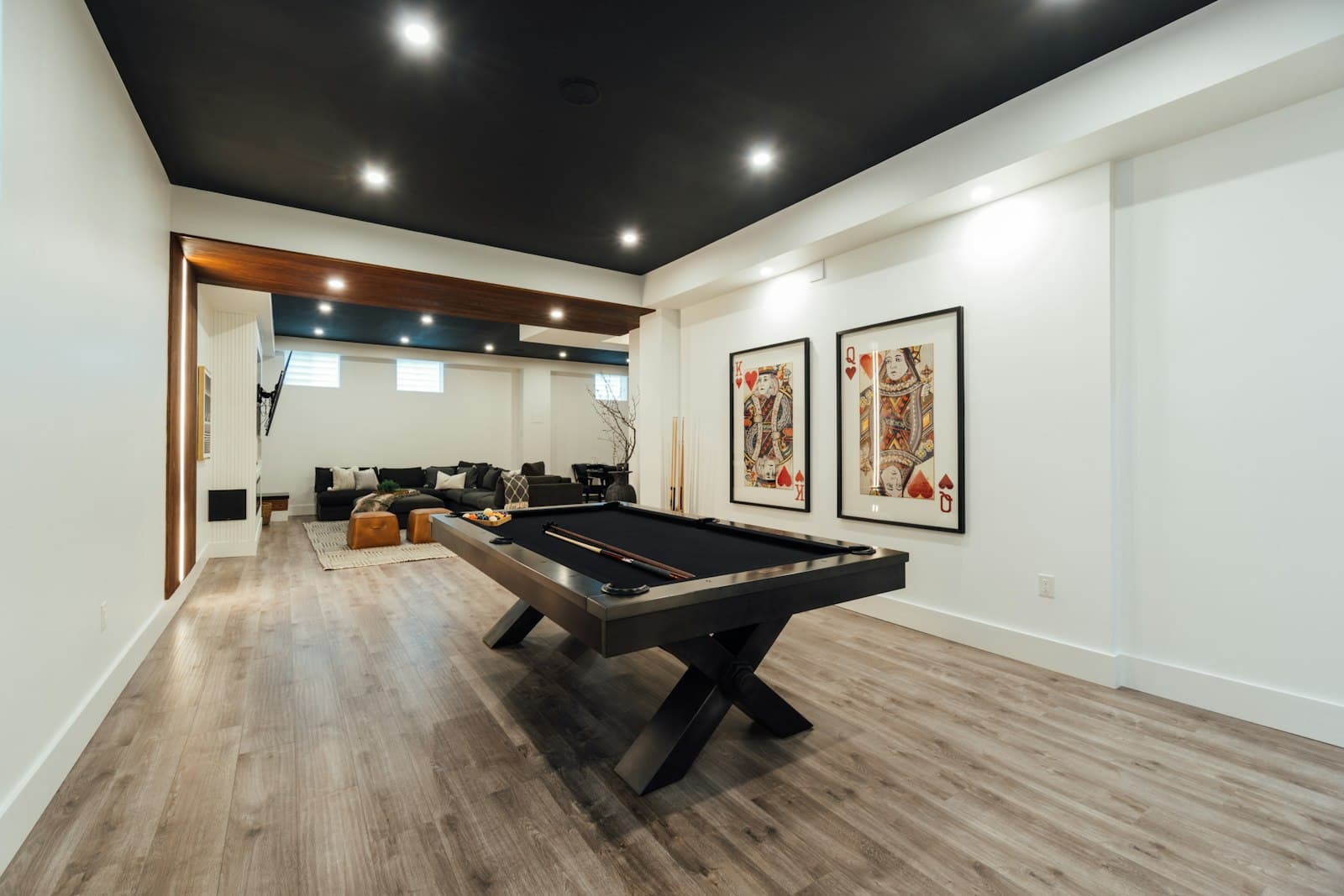
28. The Game Room Bar — Bar positioned to serve the pool table, poker table, or gaming area. Counter height designed for standing drinks during play. Usually includes a scoring display or chalkboard. $8,000-$15,000.
29. The Retro Diner Bar — Chrome-edged laminate counter, vinyl-upholstered stools, neon accent lighting, and a 1950s diner aesthetic. Fun, unexpected, and great for basements designed as entertainment space. $8,000-$15,000.
30. The Smart Bar — Integrated smart home technology: smart lighting scenes (movie mode, party mode, cleanup mode), smart beverage cooler with app temperature control, tablet-mounted recipe display, and voice-controlled music. Bar design is modern minimalist to keep the focus on technology. $12,000-$25,000 including tech.
31. The Cigar Lounge Bar — Bar combined with a ventilated cigar lounge area. Requires dedicated HVAC with exhaust ventilation (not recirculated into the home), air purification, and sealed construction to contain smoke. NJ has no state law prohibiting smoking in private residences, but the ventilation build-out is the cost driver. $20,000-$40,000 including ventilation system.
Layout Planning: Where to Put the Bar#
Against a Wall (Most Common)#
The bar counter runs along one wall. Guests sit on stools facing the wall. The bartender works behind the counter with the wall as the back bar.
Pros: Simplest layout, smallest footprint, easiest to plumb (wall access to supply and drain lines). Cons: The bartender faces the wall, not the room. Seating is linear, not social. Best footprint: 8-12 feet of wall length, 24-30 inches of counter depth, plus 36-42 inches of clearance behind the stools.
Peninsula (Popular)#
The bar extends perpendicular from a wall, creating an L-shape or T-shape. Guests sit on the open side facing into the room.
Pros: The bartender faces the room. Social seating arrangement. Defines the bar area from the rest of the basement. Cons: Requires more floor space. Plumbing runs may be longer. Best footprint: 6-10 feet of peninsula length, 24-30 inches of counter depth, plus 36-42 inches of clearance on the guest side.
Island (Premium)#
The bar sits in the middle of the basement as a freestanding island. Guests sit on any side.
Pros: The most social layout. 360-degree access. Makes the bar the centerpiece of the room. Cons: Highest cost (plumbing runs to the center of the floor, island construction is more complex). Requires 400+ square feet of dedicated bar space. Best footprint: 4x8 to 5x10 feet for the island, plus 36-42 inches of clearance on all sides.
Under the Stairs#
Uses the sloped space under the basement staircase for a bar niche.
Pros: Uses dead space creatively. Cozy, contained feel. Cons: Limited countertop space. Ceiling height limits what you can do (bar stools may not fit under the lowest point). Best footprint: Whatever the stairs give you — typically 4-6 feet of usable countertop with 6-7 feet of headroom at the high end.
Cabinet and Countertop Options#
Cabinets#
- Stock base cabinets: $100-$300 per linear foot. Available at Home Depot and Lowes. Quick, affordable, and functional for budget bars
- Semi-custom cabinets: $200-$500 per linear foot. More finish options, sizing flexibility, and hardware choices. Best balance of quality and cost
- Custom cabinets: $500-$1,000+ per linear foot. Built to exact specifications. Premium wood species, custom finishes, and specialty features (pull-out bottle storage, stemware drawers)
- Open shelving (no upper cabinets): $50-$150 per linear foot. Modern aesthetic, displays bottles and glassware, but everything is visible (including the mess)
Countertops#
| Material | Cost Per Sq Ft | Pros | Cons | Bar Suitability |
|---|---|---|---|---|
| Butcher block | $30-$70 | Warm, can be sanded and refinished | Requires sealing, water damage risk | Good for dry bars, not ideal around sinks |
| Granite | $50-$100 | Durable, heat-resistant, premium look | Heavy, can chip, requires periodic sealing | Excellent for wet and dry bars |
| Quartz | $60-$120 | Non-porous, zero maintenance, consistent color | Cannot handle high heat directly | Best all-around bar countertop |
| Laminate | $15-$40 | Affordable, huge variety of colors and patterns | Can chip and peel at edges, not premium | Good for budget bars |
| Concrete | $70-$130 | Industrial aesthetic, custom colors and shapes | Heavy, requires sealing, can crack | Great for rustic and industrial bars |
| Marble | $75-$150 | Stunning appearance, cool surface | Stains and etches from acids (citrus, wine) | Beautiful but high maintenance for bars |
| Epoxy | $50-$100 | Custom designs (river tables, embedded objects), waterproof | Yellows over time with UV, difficult to repair | Good for statement bars, not for everyone |
| Live-edge wood slab | $80-$200 | One-of-a-kind, organic, conversation piece | Requires finish, expensive, limited sizes | Premium statement piece |
The practical recommendation for NJ basement bars: Quartz. It is non-porous (spills wipe up without staining), requires zero maintenance, does not need sealing, and is available in hundreds of colors and patterns. It handles everything a bar throws at it.
Bar Countertop Dimensions#
Getting the dimensions right is the difference between a bar that feels right and one that feels off:
- Bar height: 42 inches (standard bar height, paired with 30-inch bar stools)
- Counter height: 36 inches (standard counter height, paired with 24-inch counter stools)
- Counter depth: 24-30 inches (18 inches minimum for a usable serving surface)
- Overhang for seating: 12-15 inches beyond the base cabinet on the guest side (10-inch minimum for knee clearance)
- Footrest rail position: 7-9 inches above the floor on the guest side (brass or stainless rail, $150-$400 for an 8-foot run)
- Spacing per seat: 24-28 inches center-to-center between stools
Lighting: The Make-or-Break Detail#
Bar lighting sets the mood more than any other design element. Get this wrong and the best-built bar feels like a cafeteria.
Over-Bar Lighting#
- Pendant lights: The classic choice. 2-3 pendant lights spaced evenly over the bar counter, hung 30-36 inches above the bar surface. Industrial, glass, or metal shades depending on style. $150-$500 per pendant
- Linear LED fixture: A single long LED fixture (or LED strip in a channel) running the length of the bar. Clean, modern, and provides even illumination. $200-$600
- Track lighting: Adjustable heads that can be aimed at the bar and the back bar. Flexible but harder to make look high-end. $150-$400
Accent Lighting#
- Under-counter LED strip: LED tape mounted under the counter overhang on the guest side. Creates a floating glow effect. $100-$300
- Back bar illumination: LED strips behind glass shelves or inside display cabinets. Makes bottles and glassware glow. $200-$500
- Toe-kick lighting: LED strip at the base of the bar cabinet. Subtle but adds depth. $100-$200
- Shelf lighting: Individual LEDs on each open shelf. $50-$150 per shelf
What to Avoid#
- Recessed can lights directly over the bar surface (creates harsh downlight and shadows)
- Fluorescent lighting anywhere near the bar (kills atmosphere)
- No dimmer (a bar needs adjustable lighting — bright for cleanup, dim for entertaining)
Plumbing Requirements for NJ Basement Bars#
Wet Bar Plumbing Basics#
- Supply lines: Hot and cold water supply from the home's main system. In basements, this usually involves tapping into existing supply lines and running new lines to the bar location
- Drain line: The drain must connect to the home's waste system. If the bar sink is below the home's sewer line (which is the case in most basements), a sewage ejector pump or up-flush system is required ($1,500-$3,000 installed)
- Dishwasher connection: If including a dishwasher, it connects to the same hot water supply and drain as the sink
- Ice maker line: A small 1/4-inch water supply line for the ice maker. Relatively simple to run
NJ Permit Requirements#
- Plumbing permit: Required for any new water supply or drain connection in NJ. The plumber must be licensed in NJ
- Electrical permit: Required if adding new circuits, outlets, or fixtures. The electrician must be licensed in NJ
- Building permit: May be required depending on the scope (new walls, structural changes). Check with your municipality
- Inspection: NJ requires inspection of plumbing rough-in before walls are closed and a final inspection after completion
Cost of Basement Bar Plumbing#
- Basic wet bar (sink only, with ejector pump): $3,000-$6,000 for the plumbing alone
- Full bar (sink, dishwasher, ice maker): $5,000-$10,000
- Draft beer system plumbing (kegerator + taps + glycol cooling): $2,000-$5,000 in addition to standard bar plumbing
What to Know Before You Build#
Ceiling Height Matters#
NJ code requires a minimum 7-foot ceiling in finished living spaces (6 feet 8 inches under beams and ductwork). Bar stools add 30-42 inches of seated height, and pendant lights hang 30-36 inches below the ceiling. In a standard 8-foot basement ceiling, this works fine. In a 7-foot ceiling, choose counter-height (36 inches) instead of bar-height (42 inches) and use flush-mount lighting instead of pendants.
Ventilation#
Basement bars — especially those with kegerators, beverage coolers, and under-counter refrigeration — generate heat. Ensure the bar area has adequate HVAC airflow or the equipment will overheat and the area will feel stuffy during gatherings.
Moisture#
NJ basements are prone to moisture. Before building a bar, ensure the basement is properly waterproofed. A bar built on a damp floor or against a wet wall will develop mold, ruin cabinetry, and create health issues. Our basement finishing cost guide covers waterproofing requirements in detail.
Floor Drain Access#
Do not build the bar over an existing floor drain. If the basement has a floor drain (most NJ basements do), leave it accessible. Build the bar at least 2-3 feet away from the drain, or design the bar so the drain remains accessible through a removable panel.
Ready to Build Your Basement Bar?#
Start with two questions: What do you want to serve, and how many people will you serve at once? A wine enthusiast building for quiet evenings needs a very different bar than a football fan building for game day crowds. The answer drives every design and budget decision.
Explore our full basement finishing services for details on how we handle the complete basement build-out — from waterproofing to bar installation. For a detailed look at basement costs, see our basement finishing cost guide for NJ. Thinking about the ceiling treatment? Our basement ceiling ideas guide covers every option.
The5thwall provides free design consultations for basement projects across Central NJ — Princeton, Lawrence, Hamilton, Ewing, West Windsor, Hopewell, Pennington, Robbinsville, and Lawrenceville. We are a licensed NJ Home Improvement Contractor (NJ licensed) with over 20 years of combined experience. Call us at (609) 954-3659 or fill out our contact form to start planning your basement bar.
Written by
The5thwall
Published April 7, 2026 · 16 min read
The5thwall is a father-and-son licensed NJ contractor based in Mercer County. Beyond the Blueprint is our journal — field-tested insights from two decades of renovation work across Central New Jersey.