In this article
- The Ceiling Decides Whether Your Basement Feels Like a Basement or a Room
- NJ Building Code: Minimum Ceiling Height
- Drop Ceiling (Suspended Ceiling): The Practical Choice
- How It Works
- Cost
- Pros
- Cons
- Best Tiles for NJ Basements
- Best For
- Drywall Ceiling: The Finished-Room Look
- Cost
- Pros
- Cons
- Dealing With Ductwork and Pipes
- Best For
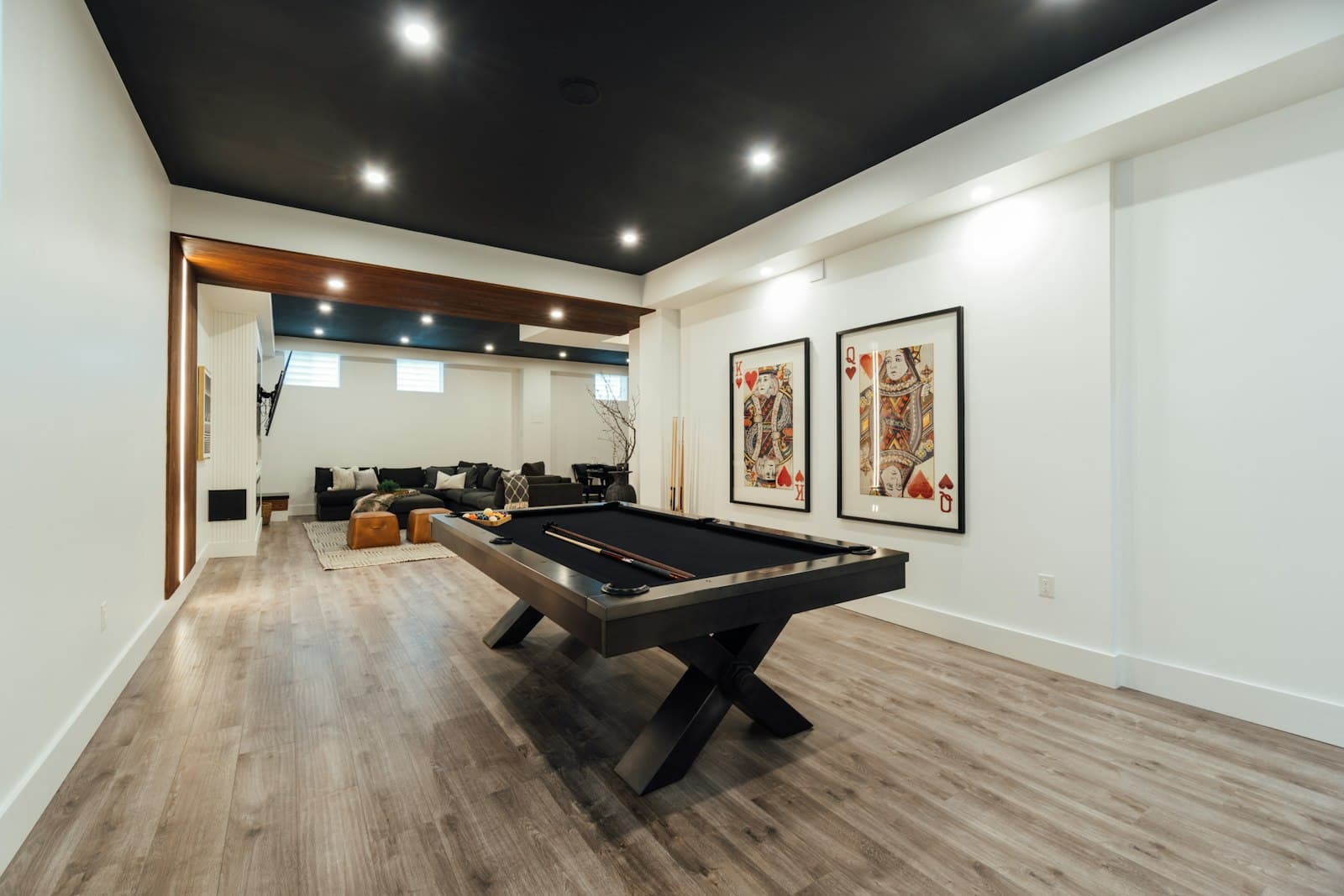
- Exposed Ceiling (Painted): The Industrial Option
- Cost
- Pros
- Cons
- Colors That Work
- Best For
- Beadboard Ceiling: The Cottage Look
- Cost
- Pros
- Cons
- Best For
- Tongue-and-Groove Wood Ceiling: The Premium Wood Option
- Cost
- Pros
- Cons
- Best For
- Coffered Ceiling: The Luxury Statement
- Cost
- Pros
- Cons
- Best For
- Stretch Ceiling: The Modern European Option
- Cost
- Pros
- Cons
- Best For
- Pressed Tin Tiles: The Vintage Character
- Cost
- Pros
- Cons
- Best For
- Ceiling Comparison Chart
- Soundproofing Your Basement Ceiling
- Methods (Best to Good)
- STC Rating Guide
- Lighting and Your Ceiling Choice
- Drop Ceiling
- Drywall
- Exposed
- Coffered
- How to Choose the Right Basement Ceiling
- Start With Your Ceiling Height
- Then Consider Your Priorities
- Ready to Finish Your Basement Ceiling?
The Ceiling Decides Whether Your Basement Feels Like a Basement or a Room#
The ceiling is the most overlooked decision in a basement finish. Homeowners spend weeks choosing flooring and paint colors, then pick a ceiling in five minutes. That is a mistake. The ceiling affects how tall the room feels, how sound travels between floors, how you access plumbing and ductwork for repairs, and whether the space reads as "finished basement" or "actual room."
NJ basements come with specific ceiling challenges — low clearance, exposed ductwork, plumbing runs, electrical conduit, and structural beams that eat into headroom. This guide covers every ceiling option that works in NJ basements, what each costs per square foot, the NJ code height requirements you must meet, and how to handle the mechanical systems that make basement ceilings complicated.
NJ Building Code: Minimum Ceiling Height#
Before choosing a ceiling type, measure your available height. NJ code dictates what is allowed:
- Minimum ceiling height for habitable space: 7 feet (84 inches) measured from the finished floor to the finished ceiling
- Allowance under beams, ducts, and soffits: 6 feet 8 inches (80 inches) minimum. These obstructions cannot cover more than 50% of the ceiling area
- Bathroom ceilings: 6 feet 8 inches minimum
- Non-habitable space (utility, storage): No minimum height requirement
What this means practically: If your basement has 8-foot ceilings (96 inches from slab to joists), you have 12 inches to work with after the 84-inch minimum. That 12 inches must accommodate the ceiling system, insulation, and any recessed lighting. A drop ceiling uses 3-6 inches. Drywall on furring strips uses 1-2 inches. An exposed ceiling uses 0 inches.
If your basement has 7-foot ceilings or less from slab to joists, your ceiling options are limited to the thinnest systems (drywall direct-mount or exposed painted). You may need to lower the floor (underpinning) to gain height, which is a major structural project ($20,000-$50,000+ in NJ).
Measure before planning. The ceiling height determines what you can do, and NJ inspectors will verify compliance.
Drop Ceiling (Suspended Ceiling): The Practical Choice#
A drop ceiling consists of a metal grid suspended from the floor joists above, with lightweight ceiling tiles resting in the grid. It is the most common basement ceiling in NJ.
How It Works#
A perimeter L-track is mounted on the walls. Main runners hang from the joists on wire hangers. Cross tees connect the runners to create a grid (typically 2x2 or 2x4 foot openings). Ceiling tiles drop into the grid.
Cost#
- Standard acoustic tiles: $3-$6 per square foot installed
- Upgraded decorative tiles (smooth, coffered-look, or textured): $5-$10 per square foot installed
- Premium tiles (metal-look, faux wood, designer): $8-$15 per square foot installed
For a 1,000 square foot basement: $3,000-$6,000 standard, $5,000-$10,000 upgraded, $8,000-$15,000 premium.
Pros#
- Access to mechanicals: Individual tiles lift out, giving you access to plumbing, ductwork, electrical, and shut-off valves above
- Hides everything: Ductwork, pipes, wires, and uneven joists disappear behind the tiles
- Sound dampening: Acoustic tiles reduce sound transmission between the basement and the floor above
- Fast installation: A 1,000 square foot drop ceiling installs in 2-3 days
- Easy repair: A damaged tile costs $2-$10 to replace
Cons#
- Height loss: 3-6 inches of headroom consumed
- Basement look: Standard acoustic tiles look institutional. Upgraded tiles mitigate this
- Grid visibility: The metal grid is always visible
- Moisture sensitivity: Standard tiles absorb moisture and sag. Use moisture-resistant tiles in NJ basements
Best Tiles for NJ Basements#
- Armstrong CeilingsDERA (vinyl-faced): Moisture-proof, washable, smooth finishes. $4-$8 per square foot
- Armstrong WoodHaven (faux wood planks in a drop grid): Transforms the look entirely. $6-$12 per square foot
- USG Radar ClimaPlus: Moisture-resistant and sag-resistant. $3-$5 per square foot
- Ceilume faux tin tiles: Decorative pressed tin patterns in lightweight PVC. $5-$10 per square foot
Best For#
Basements with active plumbing or HVAC that may need future access. Budget-conscious projects. Basements with 8+ feet slab-to-joist height.
Drywall Ceiling: The Finished-Room Look#
Drywall creates a flat, seamless ceiling identical to the rest of the home. The premium choice for making a basement feel like an above-grade room.
Cost#
- Standard drywall ceiling (flat): $4-$8 per square foot installed
- With soundproofing (double-layer): $6-$12 per square foot installed
- With soffit framing around ducts: Add $500-$2,000
For a 1,000 square foot basement: $4,000-$8,000 standard, $6,000-$12,000 with soundproofing.
Pros#
- Best appearance: Looks like any room in your house
- Minimal height loss: Less than 1 inch direct-mount, 1-2 inches with furring strips
- Soundproofing potential: Double-layer drywall with Green Glue creates excellent sound isolation
- Lighting flexibility: Recessed lights install directly in drywall with no grid constraints
- Increases home value: Appraisers perceive drywall ceilings as a finished room
Cons#
- No access to mechanicals: Accessing plumbing or wiring above requires cutting and patching
- Skilled trade: Taping and mudding a ceiling well requires experience
- Crack risk: NJ's seasonal moisture shifts can cause joint cracks
- Longer installation: 5-7 days including drying time between mud coats
Dealing With Ductwork and Pipes#
- Soffits: Box out ductwork with framed soffits covered in drywall. Well-designed soffits with integrated lighting look intentional
- Relocate ductwork: Moving ducts tighter to joists gains 2-4 inches. Costs $1,000-$4,000
- Access panels: Install removable panels at shut-off valves and junction boxes
Best For#
Basements with adequate headroom and stable plumbing. Home theaters, bedrooms, offices.
Exposed Ceiling (Painted): The Industrial Option#
An exposed ceiling leaves the joists, ductwork, pipes, and wiring visible — all painted one uniform color to create a cohesive look.
Cost#
- Professional spray painting (one color): $2-$4 per square foot
- With wire/pipe organization and cleanup: $3-$6 per square foot
For a 1,000 square foot basement: $2,000-$6,000.
Pros#
- Zero height loss: You keep every inch of headroom
- Full access to everything: All mechanicals visible and accessible
- Lowest cost: The most affordable ceiling treatment
- Industrial-modern aesthetic: Looks intentional and contemporary when done well
- Fast: Spray painting takes 1 day
Cons#
- Sound transmission: Zero sound isolation between floors
- Dust collection: Exposed elements collect dust over time
- Lighting: No recessed option. Track lighting, pendants, and surface-mount only
Colors That Work#
- Matte black: Most popular. Elements recede into darkness, creating a high-ceiling effect
- Dark charcoal (Benjamin Moore Wrought Iron): Softer than black, same visual effect
- White: Brightens the space but shows every pipe and wire
- Dark navy or forest green: Bold alternative for a cozy atmosphere
Best For#
Low-ceiling basements. Industrial-modern aesthetic. Home gyms, rec rooms, creative studios. Budget projects.
Beadboard Ceiling: The Cottage Look#
Narrow tongue-and-groove planks (typically 3.5-inch wide) with a bead detail, nailed to joists or furring strips.
Cost#
- Real wood beadboard (pine): $5-$10 per square foot installed
- PVC beadboard: $6-$12 per square foot installed
- MDF beadboard panels (4x8 sheets): $3-$7 per square foot installed
Pros#
- Warm aesthetic: Reads as intentional and detailed
- Thin profile: 3/8 to 3/4-inch thickness means minimal height loss
- NJ moisture: PVC beadboard is impervious to moisture
- Paintable: Any color works
Cons#
- No mechanical access
- Labor-intensive: Each plank individually nailed
- Style-specific: Cottage, farmhouse, or coastal aesthetic
Best For#
Cottage or traditional-styled basements. Guest suites or bedrooms.
Tongue-and-Groove Wood Ceiling: The Premium Wood Option#
Wider planks (5-8 inches) without the bead detail. Clean, modern wood ceiling.
Cost#
- Pine: $6-$12 per square foot installed
- Cedar: $8-$15 per square foot installed
- Composite/PVC: $7-$14 per square foot installed
- Reclaimed wood: $12-$25 per square foot installed
Pros#
- Natural warmth: Real wood quality no other material replicates
- Design versatility: Stain, whitewash, dark stain, or paint
- Directional options: Lengthwise, widthwise, or diagonal
- Acoustic benefit: Wood dampens sound better than hard surfaces
Cons#
- Cost: One of the more expensive options
- Moisture: Wood expands and contracts. Use kiln-dried, dehumidify to 40-50% RH
- No mechanical access
- Weight: Verify joist capacity in older NJ homes
Best For#
Premium basement finishes. Entertainment suites, home offices, bedrooms.
Coffered Ceiling: The Luxury Statement#
A grid of recessed panels framed by decorative beams — the most architecturally significant option.
Cost#
- Foam beam system: $10-$18 per square foot installed
- MDF and drywall system: $15-$25 per square foot installed
- Real wood system: $20-$40 per square foot installed
Pros#
- Dramatic visual impact: Makes a basement feel like a formal library or home theater
- Height illusion: Recessed panels create visual depth
- Lighting integration: Recessed lights install beautifully in panels between beams
Cons#
- Cost: The most expensive ceiling option
- Height requirement: Beams add 6-10 inches below joist line. Need 8.5+ foot ceilings
- Style-specific: Traditional, transitional, and formal aesthetics
- Complexity: 1-2 weeks professional installation
Best For#
High-ceiling basements (8.5+ feet). Home theaters, billiard rooms, wine cellars.
Stretch Ceiling: The Modern European Option#
A PVC or fabric membrane pulled taut between a perimeter track on the walls.
Cost#
- Standard PVC: $8-$15 per square foot installed
- Fabric: $10-$20 per square foot installed
- With integrated LED lighting: $12-$25 per square foot installed
Pros#
- Seamless: No joints, no grid lines, no visible fasteners
- Minimal height loss: About 1 inch below joists
- Moisture-proof: PVC catches water from pipe leaks. Ideal for NJ basements
- Lighting integration: Backlit effects through translucent membrane
Cons#
- Specialized installation: Not every NJ contractor offers this
- Repair difficulty: Punctures may require full panel replacement
- Access limitation: Blocks mechanical access
Best For#
Modern basements. Home theaters. Media rooms.
Pressed Tin Tiles: The Vintage Character#
Pressed tin (or aluminum/PVC replicas) with stamped decorative patterns.
Cost#
- Real tin tiles (nail-up): $8-$15 per square foot installed
- Aluminum replicas: $6-$12 per square foot installed
- PVC replicas (drop-in): $4-$10 per square foot installed
Pros#
- Unique character: Uncommon in basements, standout feature
- Multiple installation methods: Nail-up, snap-in, or drop-in
- Durable: Moisture-resistant, no sagging, lasts indefinitely
- Paintable: Any color
Cons#
- Sound reflective: Not ideal for home theaters
- Style-specific: Vintage, industrial, pub aesthetics
- Installation precision: Nail-up needs a flat surface
Best For#
Basement bars, home pubs, vintage entertainment rooms.
Ceiling Comparison Chart#
| Ceiling Type | Cost/Sq Ft | Height Loss | Mechanical Access | Soundproofing | Moisture Resistance |
|---|---|---|---|---|---|
| Drop ceiling (standard) | $3-$6 | 3-6 in | Excellent | Good | Fair |
| Drop ceiling (premium) | $8-$15 | 3-6 in | Excellent | Good | Good |
| Drywall (standard) | $4-$8 | 0.5-2 in | Poor | Fair | Fair |
| Drywall (soundproofed) | $6-$12 | 1-2 in | Poor | Excellent | Fair |
| Exposed painted | $2-$6 | 0 in | Excellent | None | N/A |
| Beadboard (PVC) | $6-$12 | 0.5-1 in | Poor | Fair | Excellent |
| Tongue-and-groove | $6-$15 | 0.5-1 in | Poor | Good | Fair |
| Coffered | $10-$40 | 6-10 in | Poor | Good | Varies |
| Stretch ceiling | $8-$25 | 1 in | Limited | Good | Excellent |
| Pressed tin tiles | $4-$15 | 0.5-1 in | Fair | Poor | Excellent |
Soundproofing Your Basement Ceiling#
Methods (Best to Good)#
- 1Decoupled double-layer drywall with Green Glue: Two layers of 5/8-inch drywall with Green Glue between them, on resilient channel. STC 55-60+. Cost: $10-$18/sqft
- 2Single-layer drywall on resilient channel + insulation: STC 45-50. Cost: $6-$12/sqft
- 3Acoustic drop ceiling tiles + insulation: STC 35-45. Cost: $5-$10/sqft
- 4Mass-loaded vinyl (MLV) + any ceiling: Adds $2-$4/sqft to any system
STC Rating Guide#
- STC 30-35: Normal speech audible through the ceiling
- STC 40-45: Loud speech audible but not intelligible
- STC 50-55: Loud speech is a faint murmur. Target for home theaters
- STC 55+: Virtually soundproof for residential use
Lighting and Your Ceiling Choice#
Drop Ceiling - Drop-in LED panels designed for suspended ceilings. Easy to relocate#
Drywall - Standard recessed cans with maximum placement flexibility. Cove lighting for indirect effects#
Exposed - Track lighting on joists. Pendant lights. Edison string lights. No recessed option#
Coffered - Recessed lights in panels between beams. LED strips in beam edges for glowing frames#
How to Choose the Right Basement Ceiling#
Start With Your Ceiling Height#
| Slab-to-Joist Height | Best Options | Avoid |
|---|---|---|
| Under 7 feet | Exposed painted only (or underpinning) | Everything else |
| 7 to 7.5 feet | Exposed, drywall direct-mount, thin beadboard | Drop ceiling, coffered |
| 7.5 to 8 feet | All options except coffered | Deep coffered |
| 8 to 8.5 feet | All including shallow coffered | Deep coffered |
| 8.5 feet and above | All options | Nothing — full flexibility |
Then Consider Your Priorities#
- Need mechanical access: Drop ceiling or exposed
- Need soundproofing: Drywall (double-layer on resilient channel) or acoustic drop ceiling
- Need moisture resistance: PVC beadboard, stretch ceiling, or moisture-resistant drop tiles
- Need premium appearance: Drywall, tongue-and-groove, or coffered
- Need lowest cost: Exposed painted or standard drop ceiling
- Need maximum headroom: Exposed painted or drywall direct-mount
Ready to Finish Your Basement Ceiling?#
The ceiling is one of the first decisions in a basement build because it affects everything else — lighting plans, soundproofing, HVAC integration, and the overall feel of the space.
Explore our full basement finishing services for details on how we handle the complete build-out. For cost breakdowns, see our basement finishing cost guide for NJ. Planning a basement bar? Our basement bar ideas guide covers 30+ designs. For the full process, read our complete guide to finishing your basement in NJ.
The5thwall provides free design consultations for basement projects across Central NJ — Princeton, Lawrence, Hamilton, Ewing, West Windsor, Hopewell, Pennington, Robbinsville, and Lawrenceville. We are a licensed NJ Home Improvement Contractor (NJ licensed) with over 20 years of combined experience. Call us at (609) 954-3659 or fill out our contact form to start planning your basement.
Written by
The5thwall
Published April 7, 2026 · 14 min read
The5thwall is a father-and-son licensed NJ contractor based in Mercer County. Beyond the Blueprint is our journal — field-tested insights from two decades of renovation work across Central New Jersey.