In this article
- Hamilton Has the Basements — and the Reasons to Finish Them
- Hamilton's Housing Stock and What It Means for Your Basement
- Post-War Cape Cods and Ranches (1940s-1960s) — Mercerville, White Horse, Yardville
- Split-Levels and Bi-Levels (1960s-1970s) — Broad Street Park, Hamilton Square
- Newer Construction (1990s-2010s) — Hamilton Crossings, Town Center
- NJ Egress Code: What Hamilton Homeowners Must Know
- Hamilton Basement Finishing Costs in 2026
- Basic Finish: $30 - $50 Per Square Foot
- Mid-Range Finish: $50 - $75 Per Square Foot
- High-End Finish: $75 - $120+ Per Square Foot
- Hamilton Permits and Inspections
- Waterproofing: Non-Negotiable in Hamilton
- What Hamilton Homeowners Are Doing with Their Basements
- Common Basement Finishing Mistakes in Hamilton
- Why Hamilton Homeowners Choose The5thwall
- Related Resources
Hamilton Has the Basements — and the Reasons to Finish Them#
Hamilton Township is the largest municipality in Mercer County, with over 90,000 residents and a housing stock that spans from post-war Cape Cods in Mercerville to newer construction in Hamilton Square and the Yardville neighborhoods. The one thing most Hamilton homes have in common: an unfinished basement that is doing nothing except storing holiday decorations and gathering dust.
That is a lot of wasted space. In a market where every square foot of livable area adds value, a finished basement in Hamilton can add 500-1,500 square feet to your home — without changing the footprint, the roofline, or the property setbacks. It is the most cost-effective way to get more space out of the home you already own.
Ready to put your basement to work? [Get a free estimate](/contact) — we will assess your space and tell you exactly what it will cost.
Hamilton's Housing Stock and What It Means for Your Basement#
Hamilton's homes were built across several decades, and each era comes with different basement characteristics:
Post-War Cape Cods and Ranches (1940s-1960s) — Mercerville, White Horse, Yardville#
These are Hamilton's most common homes — single-story or one-and-a-half-story homes built on full basements with poured concrete or block foundations.
Basement characteristics: - Ceiling heights typically 7 feet to 7 feet 6 inches from floor to joists — enough for a finished space but sometimes tight - Poured concrete or cinder block foundations — both finishable with proper waterproofing - Older mechanicals (furnace, water heater) often centrally located, requiring creative layout planning - Smaller basement windows that may need to be replaced with egress-compliant windows if adding a bedroom - Some homes in low-lying areas of Mercerville and White Horse have higher water table levels — waterproofing is especially critical here
Best basement uses: Home office, family room, playroom, guest bedroom with egress window, home gym.
Split-Levels and Bi-Levels (1960s-1970s) — Broad Street Park, Hamilton Square#
Hamilton has a significant number of split-levels and bi-levels from this era. These homes feature a unique advantage: the lower level is partially above grade, meaning it gets natural light from existing windows.
Basement characteristics: - Partially above grade = natural light and potentially existing windows that may already meet egress requirements - Ceiling heights are often generous (7 feet 6 inches to 8 feet) because the lower level was designed as a living space - Many already have roughed-in plumbing for a bathroom from the original construction - Separate outside entrance is common — ideal for creating a self-contained living space or rental unit - Existing half-bath or utility sink can be expanded to a full bathroom at lower cost than starting from scratch
Best basement uses: Entertainment suite, in-law apartment, rental unit (ADU), home theater, full living space with bathroom and kitchenette.
Newer Construction (1990s-2010s) — Hamilton Crossings, Town Center#
Newer Hamilton developments often have basements with taller ceilings, better waterproofing from the start, and modern mechanical systems that are easier to work around.
Basement characteristics: - 8 to 9-foot ceilings — ample height for a premium finished space - Poured concrete foundations with existing damp-proofing (though this is not the same as waterproofing) - Modern HVAC systems with ductwork that is easier to incorporate into the finished layout - Electrical panels typically sized for additional circuits - Builder-grade finishes above grade often prompt homeowners to finish the basement as part of an overall home upgrade
Best basement uses: Home theater, high-end entertainment space, home gym with full bathroom, rental suite, multi-room build-out with dedicated HVAC zone.
[Tell us about your Hamilton home](/contact) — we will identify what your basement can become.
NJ Egress Code: What Hamilton Homeowners Must Know#
If your finished basement will include a bedroom, New Jersey building code requires an egress window — a window large enough for emergency escape and firefighter entry. This is not optional. It is code, it is safety, and it will be verified during your final inspection.
NJ egress window requirements: - Minimum 5.7 square feet of clear opening area - Minimum 20 inches wide - Minimum 24 inches tall - Maximum 44-inch sill height from the finished floor - An exterior window well at least 36 inches from the wall if below grade - A permanent ladder or steps in the well if it is deeper than 44 inches
What this means for your Hamilton basement:
Most Hamilton basements with existing small windows will need a window replacement and window well installation to meet egress code. The process involves cutting a larger opening in the foundation wall, installing a code-compliant egress window, excavating and installing a prefabricated window well with drainage, and finishing the interior around the new opening.
Cost: $3,500-$6,500 per egress window in Hamilton, including excavation, the well, the window, and interior finishing. Most basement bedrooms need one egress window.
If your finished basement will NOT include a bedroom (home office, gym, entertainment room), egress windows are not required — though they are still a smart investment for natural light and emergency safety.
Questions about egress requirements? [Ask us during your free estimate visit](/contact).
Hamilton Basement Finishing Costs in 2026#
Here is what Hamilton homeowners are paying to finish their basements in 2026:
Basic Finish: $30 - $50 Per Square Foot#
A clean, functional space without premium finishes:
- Moisture-resistant framing and insulation
- Standard drywall (moisture-resistant on exterior walls)
- Vinyl plank or laminate flooring (never carpet in NJ basements)
- Recessed lighting
- Paint
- Basic electrical (outlets and lighting circuits)
Total for a 1,000 sq ft basement: $30,000-$50,000
Best for: Playrooms, home gyms, storage-plus-living combos, and homeowners who want functional space on a budget.
Mid-Range Finish: $50 - $75 Per Square Foot#
Better materials and more features:
- Everything in the basic finish, plus:
- Waterproof luxury vinyl plank (LVP) flooring
- Dedicated electrical sub-panel
- Multiple lighting zones with dimmers
- Dedicated HVAC zone with separate thermostat
- Half bathroom (powder room with toilet and vanity)
- Built-in shelving or entertainment wall
- Accent wall or upgraded trim
Total for a 1,000 sq ft basement: $50,000-$75,000
Best for: Family rooms, entertainment spaces, home offices, and guest suites. This is where most Hamilton homeowners land — the space feels like a natural extension of the home.
High-End Finish: $75 - $120+ Per Square Foot#
A premium living space:
- Everything in mid-range, plus:
- Full bathroom with tile shower and heated floor
- Wet bar or kitchenette with cabinetry, sink, and undercounter refrigerator
- Bedroom with code-compliant egress window
- Soundproofing between basement and first floor
- Custom built-ins and millwork
- Premium flooring (porcelain tile, engineered hardwood, or high-end LVP)
- Home theater with dedicated wiring
- Wine storage
Total for a 1,000 sq ft basement: $75,000-$120,000+
Best for: Self-contained living suites, rental units, serious entertainment spaces, and homeowners creating a high-value addition to their home.
[Get your exact Hamilton basement estimate — free and detailed](/contact).
Hamilton Permits and Inspections#
Hamilton Township's building department handles permits for basement finishing. Here is what to expect:
What requires a permit: - Framing (adding walls) - Electrical work (new circuits, outlets, lighting) - Plumbing (adding a bathroom, wet bar, or any drain/water connection) - HVAC modifications (extending ductwork, adding zones)
Permit timeline: Hamilton typically processes residential building permits in 1-2 weeks. Plan for this in your project schedule.
Inspections: Hamilton requires a rough-in inspection (after framing, electrical, and plumbing are roughed in but before drywall) and a final inspection (after all work is completed). Both must pass before the space is considered finished and legal.
We handle all of this. Permit applications, inspection scheduling, and coordination with the Hamilton building department are included in every project. You never need to visit the building department yourself.
For more on NJ permits, see our complete permits guide.
Waterproofing: Non-Negotiable in Hamilton#
Hamilton's geography includes low-lying areas along Crosswicks Creek and its tributaries, areas with clay-heavy soil that holds moisture, and neighborhoods where the water table is close to the surface. Waterproofing is not optional — it is the foundation of every basement finishing project.
Our waterproofing approach for Hamilton basements:
- 1Moisture assessment — testing concrete walls and floor for moisture content, checking for evidence of past water infiltration
- 2Interior French drain — perimeter drainage system installed along the base of foundation walls to capture water before it reaches the finished space
- 3Sump pump with battery backup — essential in Hamilton where power outages during storms are exactly when you need the pump most
- 4Vapor barrier — installed on foundation walls to prevent moisture vapor transmission through the concrete
- 5Dehumidifier — dedicated, high-capacity unit with a direct drain line (not a portable unit)
Cost: $5,000-$15,000 for a complete interior waterproofing system, depending on the basement perimeter and existing conditions.
Never finish a basement without addressing moisture first. The cost of waterproofing is always less than the cost of redoing a finished basement that got wet. This is especially true in Hamilton, where many neighborhoods have moisture challenges that are manageable with proper preparation but devastating if ignored.
[We assess your moisture situation during every free estimate visit](/contact).
What Hamilton Homeowners Are Doing with Their Basements#
Home office. Remote and hybrid work is permanent for many Hamilton residents who commute to Trenton, Princeton, or New York. A basement office with proper lighting, ventilation, and sound insulation provides a professional workspace without giving up a bedroom upstairs.
Playroom and family space. Hamilton families with young children are finishing basements as dedicated playrooms — durable waterproof flooring, washable paint, and a layout that keeps toys out of the main living areas. Many include a half bath to reduce trips upstairs.
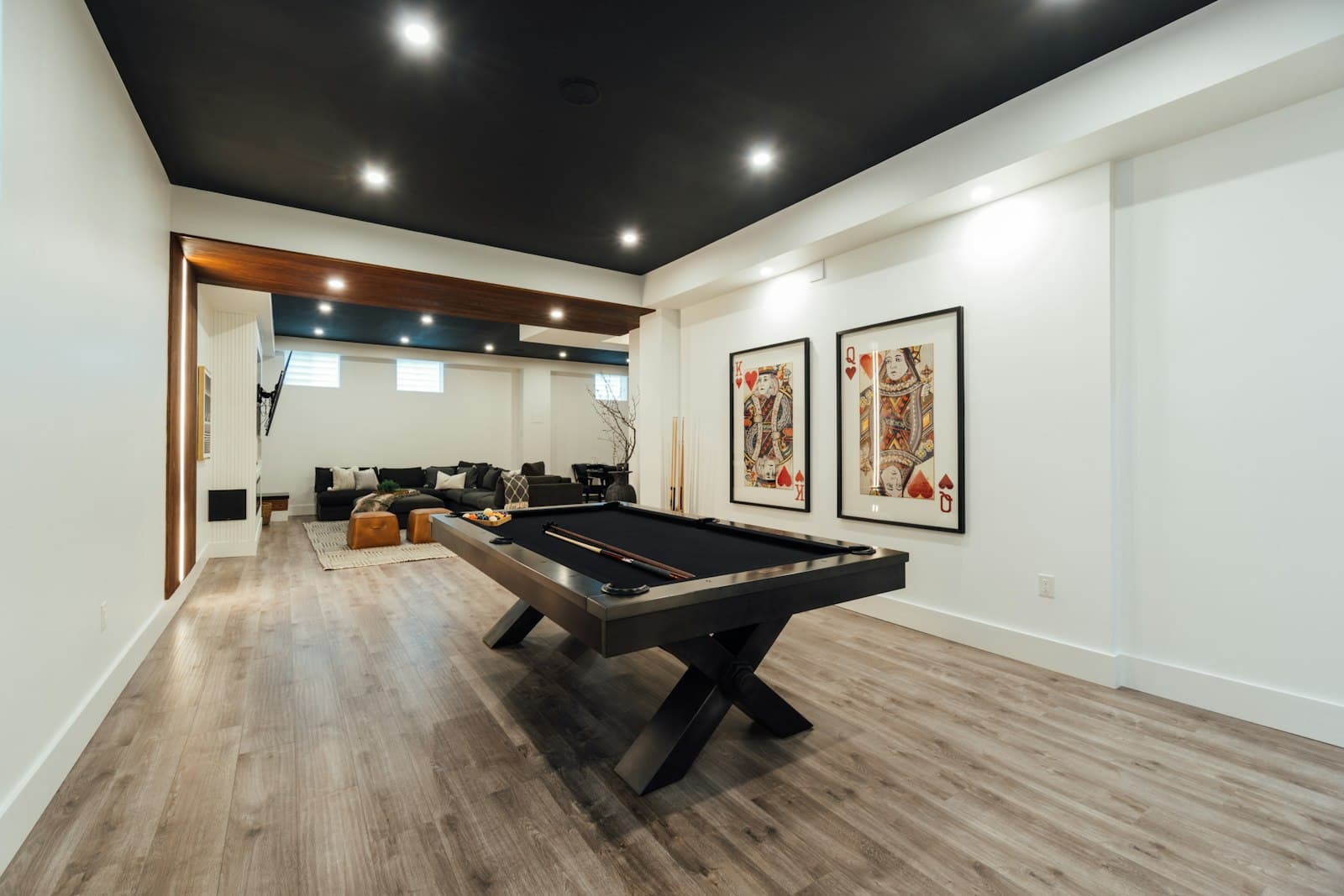
Entertainment and media room. Soundproofed basement entertainment rooms with dedicated movie and gaming setups are popular in Hamilton. The basement's naturally cool temperature and separation from the main living areas make it ideal for a dedicated entertainment zone.
Guest suite or in-law apartment. A bedroom, bathroom, and small sitting area for aging parents, adult children, or guests. Split-level Hamilton homes with separate outside entrances are particularly well-suited for this — the lower level can function as a nearly independent living space.
Home gym. Concrete subfloors handle heavy equipment, ceiling heights accommodate most machines, and the naturally cooler basement temperature is an advantage during workouts. Rubber flooring over concrete is the standard approach.
Rental unit (ADU). Hamilton Township's zoning is evolving, and some homeowners are creating accessory dwelling units (ADUs) in their finished basements — complete with kitchen, bathroom, bedroom, and separate entrance. Check current Hamilton zoning before planning a rental unit. The revenue potential in the Hamilton market makes this an attractive investment for qualifying properties.
Common Basement Finishing Mistakes in Hamilton#
1. Skipping waterproofing. We cannot say this enough. Hamilton has moisture-prone areas, and finishing a basement without proper waterproofing leads to mold, damaged materials, and a second renovation bill.
2. Using the wrong materials. No carpet in NJ basements — ever. No paper-faced drywall on foundation walls. No wood framing in direct contact with concrete. Use pressure-treated bottom plates, moisture-resistant drywall, and waterproof flooring (LVP or tile).
3. Ignoring ventilation. A finished basement needs dedicated HVAC supply and return, plus a dehumidifier. Without proper ventilation, humidity builds, odors develop, and mold follows.
4. Not planning around mechanicals. Your furnace, water heater, electrical panel, and sump pump live in the basement. A smart layout provides access to all of them without tearing open walls. Utility closets and access panels should be planned from the start.
5. Hiring unlicensed contractors. New Jersey requires all home improvement contractors to be registered with the Division of Consumer Affairs. Unlicensed contractors cannot legally pull permits, your work will not be inspected, and problems will surface when you sell. See our contractor hiring guide.
6. Not budgeting for egress windows. If you want a basement bedroom, the egress window is not optional. Budget $3,500-$6,500 per window. Discovering this requirement mid-project creates budget stress and delays.
Why Hamilton Homeowners Choose The5thwall#
Hamilton is where we do a significant portion of our work. We know the housing stock — from the ranches along White Horse-Mercerville Road to the split-levels in Hamilton Square. We know the building department, the inspectors, and the permit process.
- Stefanos and Tony — the owners — manage every Hamilton project personally. Not a crew boss, not a subcontractor. The people who quoted your project are the people who build it.
- We are 10 minutes away in Lawrence. Hamilton projects get the fastest response times and no travel surcharges.
- NJ Licensed and Insured. Home Improvement Contractor registered, $2 million liability insurance, workers' compensation. We pull every required permit and schedule every inspection.
- Free, detailed estimates. We visit your Hamilton home, assess the basement, and deliver a comprehensive written estimate with itemized costs and a realistic timeline.
[Get your free Hamilton basement estimate](/contact) — or call us directly at (609) 954-3659.
Related Resources#
- Basement Finishing Services — full details on our basement finishing capabilities
- Basement Finishing in NJ: Complete Guide — comprehensive NJ-wide guide with codes and costs
- Basement Finishing Cost Guide for NJ — detailed cost breakdown
- NJ Renovation Permits Guide — permit requirements by project type
- How to Choose a General Contractor in NJ — hiring guide
Your Hamilton basement is the biggest untapped space in your house. [Let us show you what it could become](/contact) — free estimate, no obligation. Call (609) 954-3659.
Written by
The5thwall
Published April 7, 2026 · 12 min read
The5thwall is a father-and-son licensed NJ contractor based in Mercer County. Beyond the Blueprint is our journal — field-tested insights from two decades of renovation work across Central New Jersey.