In this article
- Your Basement Is the Biggest Untapped Room in Your House
- Before You Pick an Idea: NJ Basement Realities
- Moisture and Waterproofing
- Egress Window Requirements
- Minimum Ceiling Height
- NJ Permit Requirements
- Radon Mitigation
- HVAC Extension
- Basement Remodel Cost Ranges
- 15+ Basement Remodel Ideas for NJ Homeowners
- 1. Home Office and Remote Work Space
- 2. Home Gym and Fitness Room
- 3. Wet Bar and Entertaining Area
- 4. Home Theater and Media Room
- 5. Guest Suite With Bathroom
- 6. Kids Playroom and Teen Hangout
- 7. Wine Cellar and Tasting Room
- 8. Game Room
- 9. Music Studio and Practice Room
- 10. Home Spa and Sauna
- 11. Rental Unit and Accessory Dwelling Unit (ADU)
- 12. Workshop and Maker Space
- 13. Library and Reading Room
- 14. Craft Room and Sewing Room
- 15. The Personal Retreat
- Bonus Ideas Worth Considering
- Home Classroom or Study Room
- Pet Room
- Photography or Art Studio
- Combining Ideas: Multi-Zone Basement Layouts
- What Adds the Most Value at Resale?
- How to Choose the Right Idea for Your Basement
- Working With a Licensed NJ Contractor
Your Basement Is the Biggest Untapped Room in Your House#
Most NJ homeowners are sitting on 800 to 1,500 square feet of unused space directly below their feet. That unfinished basement with the concrete floor, exposed joists, and boxes stacked against the wall is not just storage. It is the single largest opportunity to add functional living space to your home without pouring a new foundation, extending your footprint, or dealing with zoning setback restrictions.
In Mercer County, where home values in Lawrence, Princeton, Hamilton, and West Windsor have climbed steadily, a finished basement is one of the highest-ROI investments you can make. You are not adding square footage to your lot — you are activating square footage that already exists. The foundation is poured. The walls are up. The ceiling (your first floor) is framed. All you need is the right plan and the right contractor to turn that raw space into something your family uses every day.
This guide covers 15+ basement remodel ideas organized by use case, with honest cost ranges, NJ-specific building code requirements, and the real challenges that come with below-grade construction in a state where moisture, radon, and low ceiling heights are facts of life.
Before You Pick an Idea: NJ Basement Realities#
Before choosing what to build, you need to understand what you are building inside. NJ basements have specific challenges that affect every design decision. Ignoring these realities leads to mold, failed inspections, and expensive rework.
Moisture and Waterproofing#
New Jersey sits on a high water table, particularly in Mercer County. Lawrence, Ewing, and Hamilton homes frequently deal with seasonal water intrusion, hydrostatic pressure against foundation walls, and condensation on cold concrete surfaces. No basement remodel should begin without addressing moisture.
Waterproofing is not optional — it is the foundation of every project we build. This means interior drainage systems (French drains along the footing), a properly sized sump pump with battery backup, vapor barriers on walls and floor, and dehumidification. If you skip this step, every dollar you spend on framing, drywall, flooring, and finishes is at risk. We have torn out other contractors' work because they framed over wet walls and the homeowner discovered mold eighteen months later.
For a deep dive into waterproofing costs and methods, see our basement finishing cost guide for NJ.
Egress Window Requirements#
NJ building code requires egress windows in any basement room used as a bedroom or sleeping area. An egress window must have a minimum opening of 5.7 square feet, with a minimum width of 20 inches and a minimum height of 24 inches. The sill height cannot be more than 44 inches above the finished floor. If the window opens into a window well, the well must be at least 36 inches wide and project at least 36 inches from the wall, with a ladder or steps if the well is deeper than 44 inches.
This requirement affects guest suites, rental units, teen bedrooms, and any space where someone might sleep — even if you call it a "den" on the plans. Building inspectors in Lawrence, Princeton, Hamilton, and Ewing know this distinction well. If it has a closet and a door, they will ask about egress. Budget $3,000 to $6,000 per egress window including the window, cutting through the foundation wall, and the window well installation.
Minimum Ceiling Height#
NJ code requires a minimum ceiling height of 7 feet (84 inches) in habitable finished space. Beams, ducts, and soffits can drop to 6 feet 8 inches (80 inches) as long as they do not cover more than 50 percent of the ceiling area. This is measured from the finished floor to the finished ceiling — so your flooring thickness and ceiling system both eat into your available height.
If your basement measures 96 inches (8 feet) from the concrete slab to the bottom of the floor joists, you have 12 inches of room for flooring (typically 0.5 to 1 inch), ceiling system (1 to 6 inches depending on type), and insulation. That math gets tight fast, especially if you have ductwork running below the joists. Measure before you plan, and read our basement ceiling ideas guide for options that maximize headroom.
NJ Permit Requirements#
Any basement finishing project that includes framing, electrical, plumbing, or HVAC work requires permits in New Jersey. This is not a suggestion — it is law. Your municipality (Lawrence Township, Princeton, Hamilton, Ewing, etc.) will require:
- A construction permit for framing and structural work
- An electrical permit for any new circuits, outlets, or lighting
- A plumbing permit if adding a bathroom, wet bar, or any water supply/drain lines
- A mechanical permit if extending or modifying HVAC ductwork
Unpermitted work creates liability at resale, can void your homeowner's insurance, and will be flagged during home inspections. We handle all permit applications and scheduling as part of our basement finishing services. For a comprehensive overview, see our NJ building permits guide.
Radon Mitigation#
Radon is a colorless, odorless radioactive gas that seeps through foundation cracks and is a leading cause of lung cancer. Mercer County has some of the highest radon levels in New Jersey. The EPA recommends mitigation for any home testing above 4 pCi/L, and many Mercer County homes test well above that threshold.
If you are finishing your basement, this is the time to install radon mitigation. A sub-slab depressurization system costs $800 to $1,500 when installed during construction (before the floor is sealed) versus $1,500 to $3,000 as a retrofit after the basement is finished. Test before you build, and integrate mitigation into the construction plan.
HVAC Extension#
Your existing furnace and air conditioning system was sized for your above-grade living space. Adding 800 to 1,500 square feet of conditioned basement space means your HVAC system needs to handle additional load. Options include extending existing ductwork (if capacity allows), adding a dedicated mini-split system for the basement, or supplementing with electric baseboard heat.
Mini-splits are the most popular choice for basement remodels in NJ because they provide both heating and cooling, operate independently from the main system, and do not require ductwork. A single-zone mini-split installed costs $3,000 to $5,000. Multi-zone systems for larger basements run $6,000 to $12,000.
Basement Remodel Cost Ranges#
Before we get into specific ideas, here are the realistic cost ranges for basement remodels in Central NJ as of 2026:
| Project Type | Cost Range |
|---|---|
| Basic finished space (framing, drywall, flooring, lighting) | $30,000 - $50,000 |
| Mid-range with bathroom | $50,000 - $80,000 |
| High-end entertainment space | $70,000 - $120,000 |
| Full guest suite or rental unit | $80,000 - $150,000+ |
These ranges assume a 1,000-square-foot basement. Smaller basements cost less in total but more per square foot. Larger basements benefit from economies of scale. Every project is different — the only way to get an accurate number is a site visit and detailed estimate.
15+ Basement Remodel Ideas for NJ Homeowners#
1. Home Office and Remote Work Space#
Remote work is not going away, and a basement home office solves the two biggest problems with working from home: noise and separation. A dedicated below-grade office puts a full floor between your workspace and the household noise above — kids, pets, kitchen activity, doorbells.
Key design elements: - Dedicated electrical circuit for computer equipment (20-amp minimum) - Hardwired ethernet connection (do not rely on WiFi through a concrete floor) - Task lighting and ambient lighting on separate switches - Sound insulation in the ceiling (mineral wool batts between joists) - Egress window or generous window well for natural light - Climate control via mini-split or dedicated HVAC zone
NJ considerations: If you are claiming a home office tax deduction, the space must be used exclusively for work. A finished basement office with a door satisfies this requirement. Ensure the ceiling height meets the 7-foot minimum for habitable space.
Cost range: $35,000 - $55,000 for a dedicated office with built-in desk, shelving, separate entrance feel, and proper climate control.
2. Home Gym and Fitness Room#
A basement gym eliminates every excuse for skipping a workout. The below-grade location provides naturally cool air (basements in NJ average 55-65 degrees year-round without conditioning), concrete subfloor that handles heavy equipment without flexing, and ceiling heights that accommodate most exercises.
Key design elements: - Rubber flooring or interlocking foam tiles over concrete (protects equipment and dampens noise) - Reinforced floor areas for heavy equipment (squat racks, deadlift platforms) - Floor-to-ceiling mirrors on at least one wall - Ventilation — basements trap humidity, and adding sweating humans makes it worse - Dedicated 20-amp circuits for treadmills and other motorized equipment - Sound system and TV mounting
NJ considerations: Heavy equipment like power racks and plate-loaded machines can weigh 500 to 1,000+ pounds when loaded. NJ basement concrete slabs can handle this, but verify there are no cracks or settling issues first. Moisture control is critical — sweat plus existing basement humidity equals mold without proper dehumidification.
Cost range: $30,000 - $50,000 for a finished gym space (not including equipment). Equipment adds $2,000 to $20,000+ depending on your setup.
3. Wet Bar and Entertaining Area#
A basement wet bar is the single feature that transforms a finished basement from bonus room to destination. In NJ, where entertaining at home is a year-round activity, a well-designed bar area turns your basement into the place everyone wants to be.
Key design elements: - Wet bar with sink (requires plumbing permit and likely a sewage ejector pump) - Beverage cooler and/or kegerator - Bar counter with overhang for seating (3-4 stools minimum) - Under-cabinet lighting and accent lighting - Durable countertop (quartz is the best choice for spill resistance) - Open floor plan connecting to seating and TV areas
NJ considerations: Basements are typically below the sewer line, so any sink or drain needs a sewage ejector pump. This adds $2,000 to $4,000 to the plumbing cost. Plumbing permits are required. For a deep dive into bar designs, layouts, and costs, see our complete basement bar ideas guide.
Cost range: $50,000 - $80,000 for a finished entertaining space with wet bar, seating area, and proper lighting.
4. Home Theater and Media Room#
A basement is the ideal location for a home theater because it is naturally dark, isolated from street noise, and separated from the rest of the house so you can crank the volume without disturbing anyone upstairs.
Key design elements: - Acoustic treatment on walls and ceiling (sound absorption panels, bass traps in corners) - Light control (no windows, or blackout treatments on egress windows) - Tiered seating platform (raised back row for unobstructed sightlines) - Dedicated electrical for projector, screen, AVR, and speakers - In-wall or in-ceiling speaker wiring (run during framing, before drywall) - Proper ventilation (sealed rooms get warm with electronics and people) - Sound isolation in the ceiling to prevent movie audio from bleeding upstairs
NJ considerations: If you are building a true theater room (enclosed, dedicated), ensure it still meets the 7-foot ceiling height requirement. Tiered seating platforms raise the back row 8 to 12 inches, which means your effective ceiling height in the back drops accordingly. Plan for this in your design. Acoustic insulation between the basement ceiling and the first floor is worth every dollar in a two-story NJ home.
Cost range: $70,000 - $120,000 for a dedicated theater with acoustic treatment, tiered seating, projector, screen, and surround sound. A simpler media room with a large TV and comfortable seating runs $40,000 - $65,000.
5. Guest Suite With Bathroom#
A basement guest suite gives visitors a private, self-contained space — bedroom, bathroom, and sitting area — without displacing anyone from their regular room upstairs. In Mercer County, where extended family visits are common and home prices make guest houses impractical, a basement guest suite is the practical solution.
Key design elements: - Private bedroom area with egress window (required by NJ code for sleeping rooms) - Full or three-quarter bathroom (toilet, sink, shower) - Small sitting area or reading nook - Closet for guest storage - Separate climate control (mini-split) - Sound insulation for privacy - Quality lighting — basements need more artificial light than above-grade rooms
NJ considerations: The egress window is non-negotiable for any room used for sleeping. Budget $3,000 to $6,000 for the window installation. The bathroom requires plumbing permits and likely a sewage ejector system. If you plan to list the suite on Airbnb or as a rental, additional NJ regulations apply (see Idea 11 below).
Cost range: $80,000 - $120,000 for a complete guest suite with full bathroom, bedroom, and sitting area.
6. Kids Playroom and Teen Hangout#
A basement playroom solves the eternal problem of toys and kid chaos taking over your main living space. For younger kids, it is a dedicated zone for play. For teenagers, it becomes the hangout spot that keeps them (and their friends) at your house instead of somewhere else.
Key design elements: - Durable, easy-to-clean flooring (LVP or rubber tiles — never carpet in a NJ basement) - Built-in storage (cubbies, shelving, toy bins) to manage the clutter - Bright, cheerful lighting (LED panels or recessed lights) - TV and gaming setup for older kids - Craft or homework table - Sound insulation so noise does not travel upstairs - Baby gate or door at the stairs for younger children
NJ considerations: Safety is the priority. Ensure stairway handrails meet code (34 to 38 inches high, graspable profile). Outlet covers on all receptacles for young children. If the playroom includes a bedroom component for sleepovers, egress window requirements apply. Moisture control is especially important in play spaces — kids on damp floors develop allergies and respiratory issues.
Cost range: $30,000 - $50,000 for a finished playroom with storage, flooring, and proper lighting. Add $10,000 - $15,000 for a dedicated teen hangout with gaming setup and media area.
7. Wine Cellar and Tasting Room#
A basement wine cellar leverages the one thing basements do naturally — stay cool. Below-grade spaces in NJ maintain temperatures in the 55 to 65 degree range year-round, which is close to the ideal 55-degree storage temperature for wine. With proper climate control, your basement becomes a genuine cellar.
Key design elements: - Climate-controlled room with dedicated cooling unit (CellarPro, WhisperKOOL, or similar) - Insulated walls and ceiling (R-19 minimum) with vapor barrier to maintain temperature - Wine racking — wood (redwood or mahogany), metal, or custom stone alcoves - Tasting counter or small bar area - Ambient lighting (LED strips in racks, dimmable overhead) — no fluorescent - Stone, brick, or wood accent walls for atmosphere - Proper door with weatherstripping to seal the conditioned space
NJ considerations: The cooling unit vents heat, so it needs to exhaust into an adjacent unconditioned space or through a duct to the exterior. In NJ, where summer humidity is high, the vapor barrier and insulation are critical to prevent condensation inside the cellar. A poorly sealed cellar in a Mercer County basement will drip condensation all summer. Homes in Princeton, Hopewell, and Pennington with older stone foundations need extra attention to moisture management.
Cost range: $70,000 - $120,000 for a climate-controlled wine cellar with tasting area, custom racking, and premium finishes. A smaller wine wall or display without full climate control runs $15,000 - $30,000.
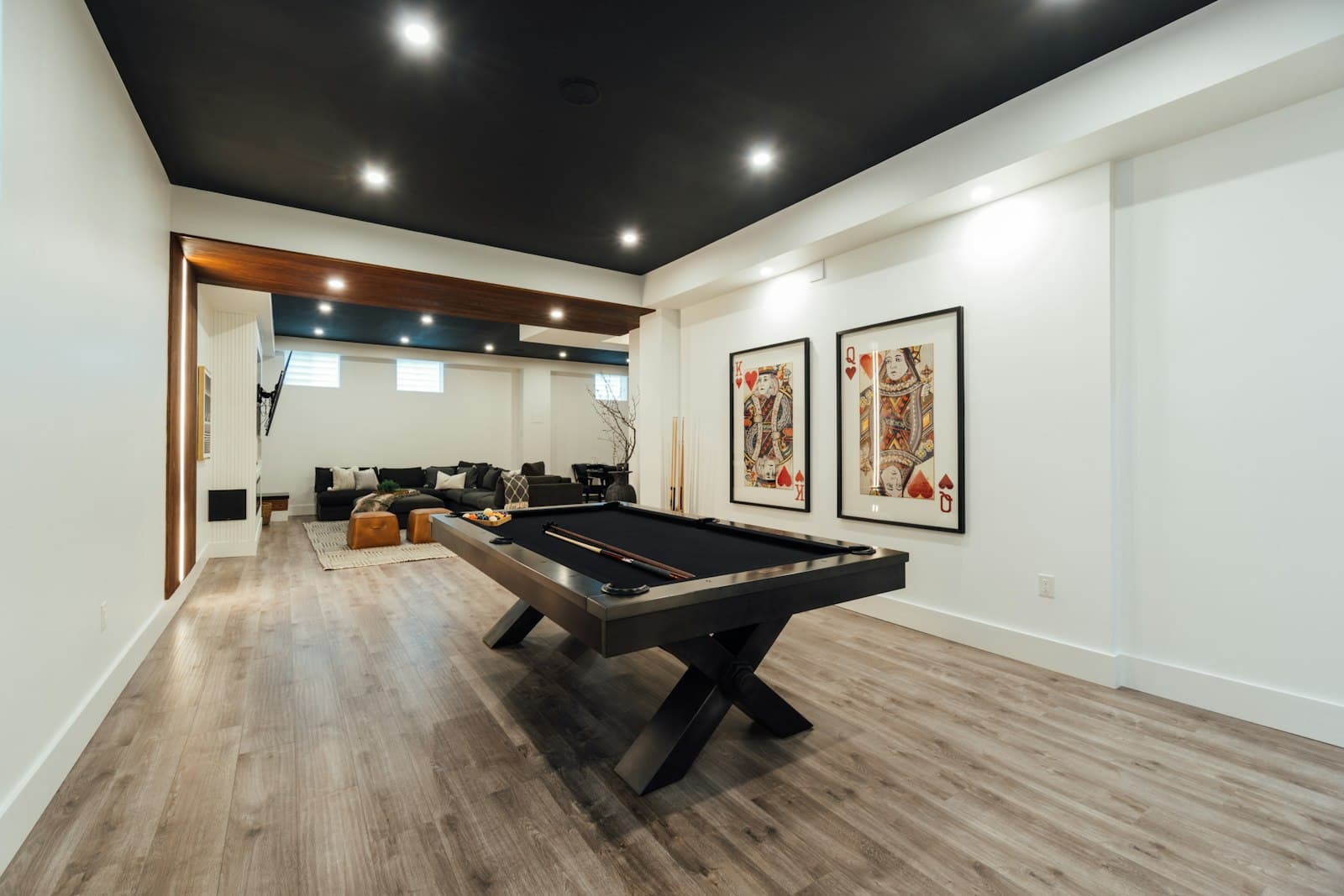
8. Game Room#
A basement game room is dedicated fun — pool table, darts, shuffleboard, arcade machines, card table, and board games — all in one space where you do not have to worry about noise levels or bumping furniture in the living room.
Key design elements: - Pool table (requires minimum 5 feet of clearance on all sides for cue strokes) - Dart board area with proper throw distance (7 feet 9.25 inches from face of board to throw line) - Arcade machines or gaming console setup - Card table or multi-purpose game table - Proper lighting (pool table light centered 36 inches above the playing surface) - Bar area or beverage station (see Idea 3) - Durable flooring that handles foot traffic, dropped darts, and pool cue chalking
NJ considerations: A regulation pool table (8-foot) with 5-foot clearance on all sides requires a room at least 18 feet by 14 feet. Measure your basement before committing to a table size. Ceiling height matters — you need clearance for a full cue stroke, which means 7-foot ceilings work but feel tight. If your basement has 8-foot ceilings, game room ergonomics work well. Consider acoustics — game rooms get loud, and sound insulation in the ceiling keeps the noise from traveling upstairs.
Cost range: $40,000 - $70,000 for a finished game room space (not including game equipment). Equipment adds $3,000 to $15,000+ depending on what you include.
9. Music Studio and Practice Room#
A basement music studio puts concrete walls and a full floor between your instruments and the rest of the house. For musicians, drummers, bands, and music producers, the below-grade location provides natural sound isolation that above-grade rooms cannot match.
Key design elements: - Sound isolation — double-wall construction (staggered stud or resilient channel) on all walls - Floating floor (decoupled from the concrete slab) to prevent bass transmission - Acoustic treatment (absorption panels, diffusers, bass traps) for room sound quality - Isolated electrical circuits (separate from household to eliminate buzz and interference) - Dedicated HVAC that does not share ductwork with the rest of the house (duct-transmitted sound) - Proper lighting on dimmers - Recording booth or vocal isolation area if needed
NJ considerations: Sound isolation is the entire point. NJ homes are close together — in Lawrence, Hamilton, Ewing, and Robbinsville subdivisions, your neighbor's bedroom might be 30 feet from your basement wall. Full sound isolation (STC rating of 60+) requires investment but prevents noise complaints. The concrete foundation walls help significantly — above-grade studios cannot match below-grade isolation without spending far more on construction.
Cost range: $50,000 - $90,000 for a properly isolated music studio with acoustic treatment. A simpler practice room without full isolation runs $35,000 - $55,000.
10. Home Spa and Sauna#
A basement spa brings the relaxation experience home — steam shower, sauna, soaking tub, and relaxation lounge in a private, below-grade retreat. The naturally cool, quiet basement environment enhances the spa atmosphere.
Key design elements: - Steam shower with bench seating, body jets, and rainfall showerhead - Sauna (prefabricated electric sauna units fit in a 6x8-foot space) - Soaking tub or Japanese ofuro - Heated floors (electric radiant heat under tile) - Moisture-resistant materials throughout (porcelain tile, cement board, no drywall in wet areas) - Proper ventilation — steam rooms and saunas produce massive moisture that must be exhausted - Ambient lighting and sound system
NJ considerations: A basement spa generates enormous amounts of moisture. In a state where basements already struggle with humidity, ventilation is not optional — it is the most important design element. The steam shower and sauna need dedicated exhaust fans venting directly to the exterior. All electrical in wet areas must meet NJ code for GFCI protection and appropriate ratings for wet locations. Plumbing permits are required for any water supply and drain work.
Cost range: $80,000 - $150,000+ for a full home spa with steam shower, sauna, soaking tub, and relaxation area. A simpler spa bathroom with steam shower and heated floors runs $50,000 - $80,000.
11. Rental Unit and Accessory Dwelling Unit (ADU)#
Converting your basement into a rental unit is the only basement remodel idea that pays for itself. A legal basement apartment in Mercer County can generate $1,200 to $2,000+ per month in rental income, and NJ has been expanding ADU regulations to make this more accessible.
Key design elements: - Separate entrance (exterior stairwell or dedicated entry) - Full kitchen (sink, stove, refrigerator, adequate counter space) - Full bathroom (toilet, sink, shower or tub) - Bedroom with egress window (code required) - Living area - Dedicated HVAC (separate climate control from the main house) - Separate electrical panel or sub-panel - Sound insulation between the unit and the main house - Smoke and carbon monoxide detectors per NJ fire code
NJ considerations: NJ rental unit regulations are strict. Your municipality must allow accessory dwelling units — not all do. Lawrence Township, Princeton, and Hamilton have different zoning rules for basement apartments. You will need: - Zoning approval or variance - Construction permits (building, electrical, plumbing, mechanical) - Certificate of Occupancy - Compliance with NJ fire code (two means of egress, fire-rated separations, interconnected smoke alarms) - Compliance with NJ habitability standards (minimum room sizes, ceiling heights, ventilation, natural light) - Landlord registration with the municipality
This is the most complex basement remodel from a regulatory standpoint. Work with a contractor who understands NJ rental conversion requirements. Cutting corners on permits and code compliance creates massive legal liability.
Cost range: $80,000 - $150,000+ for a legal, code-compliant rental unit with kitchen, bathroom, bedroom, and separate entrance.
12. Workshop and Maker Space#
A basement workshop is the ideal space for woodworking, metalworking, 3D printing, electronics, and general making. The concrete floor handles heavy equipment, the below-grade walls dampen noise, and the separation from living space keeps sawdust and fumes contained.
Key design elements: - Heavy-duty workbench (built-in or freestanding) - Pegboard or French cleat wall system for tool storage - Adequate electrical — 20-amp circuits minimum, 240V outlet for table saws and welders - Dust collection system (critical for woodworking — basement dust gets into HVAC) - Ventilation and exhaust fan for fumes (paint, solvents, welding) - Bright overhead lighting (LED shop lights, 5000K color temperature) - Rubber mat flooring in standing work areas - Fire extinguisher rated for your materials
NJ considerations: If your workshop involves woodworking, install a dust collection system that exhausts outside or through a HEPA filter. Sawdust in basement HVAC ductwork is a fire hazard. Any 240V electrical work requires an NJ-licensed electrician and an electrical permit. If you are doing welding or work with flammable materials, check your homeowner's insurance — some policies exclude or limit coverage for workshop activities.
Cost range: $30,000 - $55,000 for a finished workshop space with proper electrical, lighting, ventilation, and storage. Does not include tools and equipment.
13. Library and Reading Room#
A basement library creates a quiet retreat that the rest of the house cannot offer. Below-grade rooms are naturally quiet — concrete walls and earth block exterior noise — making them ideal for reading, studying, and focused work.
Key design elements: - Built-in bookshelves (floor-to-ceiling, custom or modular) - Comfortable reading chairs and task lighting - Warm, inviting materials (wood paneling, area rugs over hard flooring) - Ambient lighting with focused reading lamps - Climate control tuned for comfort and book preservation (humidity between 30-50%) - Window seat at egress window for natural reading light - Sound insulation from adjacent basement spaces
NJ considerations: Humidity is the enemy of books. NJ basement humidity can reach 70-80% in summer without dehumidification. Keep humidity between 30 and 50 percent to prevent mold on book covers and pages. A dedicated dehumidifier or whole-basement dehumidification system is essential. Homes in West Windsor, Hopewell, and Pennington with older construction need particular attention to humidity management.
Cost range: $35,000 - $60,000 for a finished library with built-in shelving, reading area, and proper climate control.
14. Craft Room and Sewing Room#
A dedicated craft space means no more commandeering the dining room table for projects, no more storing supplies in closets throughout the house, and no more half-finished work that has to be cleaned up before dinner.
Key design elements: - Large work table (counter height, 36 inches) with overhang for seating - Extensive storage — built-in cabinets, pegboard, drawer systems, and open shelving for supplies - Task lighting — bright, color-accurate LED lights (5000K, high CRI) for color-matching fabric and paint - Ironing station (built-in or fold-down) - Sink for cleanup (wet crafts, painting, dyeing) - Durable, easy-to-clean flooring (LVP or tile — dropped paint and glue clean up easily) - Electrical outlets every 4 feet around the perimeter (sewing machines, cutting machines, heat presses)
NJ considerations: Adequate electrical is important. A single 15-amp circuit will not support a sewing machine, iron, Cricut cutter, and lamp simultaneously. Plan for two to three dedicated 20-amp circuits in a craft room. If adding a sink, plumbing permits apply. Humidity control matters for fabric storage — damp fabric develops mildew and becomes unusable.
Cost range: $35,000 - $55,000 for a finished craft room with built-in storage, work surfaces, and proper lighting.
15. The Personal Retreat#
Whether you call it a man cave, a she shed equivalent, a lounge, or simply your room — the concept is the same. A dedicated personal space where you can relax, pursue hobbies, watch what you want, and decompress without competing for the living room.
Key design elements: - Comfortable seating (reclining sofa, oversized chair, or sectional) - Entertainment center (large TV, sound bar or surround sound, gaming console) - Mini bar or beverage station - Personal hobby area (display cases, memorabilia wall, reading corner) - Lighting on dimmers for mood control - Sound system (consider soundproofing if you like it loud) - Temperature control independent from the main house
NJ considerations: This is the most flexible basement remodel because there are no special code requirements beyond the standard finished basement minimums (ceiling height, egress for sleeping, electrical load). The key decision is whether to make it a multi-purpose space or a dedicated single-use room. In NJ, where basement square footage is valuable, most homeowners get more value from a multi-purpose approach — personal retreat that can also function as a guest space, home theater, or game room.
Cost range: $35,000 - $65,000 depending on the level of finish and features included.
Bonus Ideas Worth Considering#
Home Classroom or Study Room#
With the growth of homeschooling and hybrid learning in NJ, a dedicated classroom space in the basement gives kids a focused learning environment. Built-in desks, whiteboard wall, computer stations, and bookshelves create a school-like environment at home. Cost: $30,000 - $45,000.
Pet Room#
A basement pet space with washable flooring, a dog wash station (tiled shower area with handheld sprayer), and indoor play area keeps mud and pet mess out of your main living space. Especially useful during NJ winters when outdoor time is limited. Cost: $30,000 - $50,000 with dog wash station.
Photography or Art Studio#
The controlled lighting conditions of a basement (no shifting natural light) make it ideal for photography studios and art spaces. Dedicated lighting rigs, backdrop walls, and easy-to-clean flooring serve both photographers and painters. Cost: $35,000 - $60,000.
Combining Ideas: Multi-Zone Basement Layouts#
Most basements are large enough to accommodate two or three uses. The key is thoughtful zoning — dividing the space with partial walls, ceiling height changes, flooring transitions, and lighting zones rather than boxing everything into separate rooms. Open layouts feel larger, cost less to build, and offer more flexibility.
Popular Mercer County combinations we build frequently:
- Entertainment zone: Wet bar + game room + media area (open plan)
- Family zone: Playroom + home office + guest bedroom (separated by walls for privacy)
- Active zone: Home gym + spa bathroom + changing area
- Income zone: Rental unit (fully separated, code-compliant)
- Hobby zone: Workshop + craft room + storage (dust separation between workshop and clean areas)
When planning a multi-zone basement, consider traffic flow, noise separation, and plumbing clustering. Bathrooms, wet bars, and kitchenettes should share plumbing walls to reduce cost. Noisy activities (gym, game room, workshop) should be separated from quiet activities (office, library, bedroom) by at least one wall.
What Adds the Most Value at Resale?#
Not all basement remodel ideas add equal value at resale. Based on NJ real estate trends and appraiser feedback in Mercer County:
Highest ROI: - Full bathroom addition (70-80% return) - Legal rental unit / ADU (pays for itself over time) - General finished space with flexible layout (65-75% return) - Home office (increasingly valued by buyers)
Good ROI: - Guest suite (60-70% return) - Entertainment area with wet bar (55-65% return) - Home gym (55-65% return)
Lower ROI (but high personal value): - Wine cellar (40-50% return — niche appeal) - Music studio (40-50% return — specialized construction) - Home theater (40-55% return — technology changes rapidly)
The best basement remodel is the one that improves your daily life first and adds resale value second. Build for how you actually live, not for a hypothetical future buyer.
How to Choose the Right Idea for Your Basement#
Ask these five questions:
- 1What does your family need most? If you are tripping over toys, build the playroom. If you are working from the kitchen table, build the office. Solve a real problem first.
- 1What is your ceiling height? If you have 8+ feet, all options are open. If you have 7 to 7.5 feet, skip the home theater with tiered seating and the wine cellar with barrel-vaulted ceiling. Low ceilings favor open, flexible spaces over enclosed rooms.
- 1What is your moisture situation? If your basement has active water issues, budget for waterproofing before anything else. A $100,000 basement remodel on top of a $5,000 waterproofing problem is a recipe for disaster.
- 1What is your budget? Be honest about the total investment. A half-finished basement is worse than an unfinished one — at least the unfinished basement has potential. Finish what you start.
- 1Do you want income or enjoyment? If income, pursue the rental unit (Idea 11). If enjoyment, pick the idea that your family will use most frequently. The best basement remodel is the one that gets used every day, not the one that looks impressive on Instagram.
Working With a Licensed NJ Contractor#
Basement remodels in New Jersey require licensed contractors, proper permits, and code-compliant construction. This is not a DIY project — framing, electrical, plumbing, and HVAC work must be performed by licensed professionals and inspected by your municipal building department.
When evaluating contractors for your basement remodel, verify:
- NJ Home Improvement Contractor (HIC) license
- General liability insurance ($1M minimum, $2M preferred)
- Workers' compensation insurance
- References from local projects (ask for Mercer County work specifically)
- Willingness to pull permits and schedule inspections
- A detailed, written contract with scope, timeline, payment schedule, and warranty
The5thwall is a licensed NJ Home Improvement Contractor with $2M in insurance coverage. We are a father-and-son team serving Lawrence, Princeton, Hamilton, Ewing, Hopewell, West Windsor, Pennington, and Robbinsville. We handle every phase of basement remodeling — from waterproofing and permits to final trim and cleanup.
Call us at (609) 954-3659 or visit our basement finishing services page to schedule a free consultation and get a detailed estimate for your basement remodel.
Written by
Tony Karpontinis
Published April 13, 2026 · 18 min read
The5thwall is a father-and-son licensed NJ contractor based in Mercer County. Beyond the Blueprint is our journal — field-tested insights from two decades of renovation work across Central New Jersey.