In this article
- Quartz vs Granite: The Two Best Countertop Materials for NJ Kitchens
- The Quick Comparison
- What Quartz Actually Is
- What Granite Actually Is
- Cost Comparison for NJ Kitchens
- Quartz Pricing in Central NJ (2026)
- Granite Pricing in Central NJ (2026)
- What a Typical NJ Kitchen Costs
- Maintenance: The Biggest Practical Difference
- Quartz Maintenance
- Granite Maintenance
- Durability in NJ's Climate
- Humidity Performance
- Temperature Stability
- Freeze-Thaw (Outdoor Kitchens)
- Appearance and Design Flexibility
- Quartz Aesthetics
- Granite Aesthetics
- Resale Value Impact in NJ
- Quartz Resale Performance
- Granite Resale Performance
- The Market Trend
- Health and Safety Considerations
- Quartz
- Granite
- Environmental Considerations
- Quartz
- Granite
- Edge Profiles and Fabrication
- Which Should You Choose?
- Choose Quartz If:
- Choose Granite If:
- Choose Both If:
- What About Quartzite?
- Getting the Best Price in NJ
- Buying Tips
- Installation: What to Expect
- Our Recommendation
- Ready to Compare Materials in Person?
Quartz vs Granite: The Two Best Countertop Materials for NJ Kitchens#
If you are remodeling a kitchen in New Jersey, the countertop decision usually comes down to two materials: quartz and granite. Both are premium surfaces that add real value to your home. Both look great and last decades. But they are fundamentally different materials with different strengths, maintenance demands, and price points.
This guide compares quartz and granite specifically for NJ homeowners — not generic national advice, but the considerations that matter when your kitchen deals with New Jersey's humid summers, dry heated winters, and a housing market where countertop selection directly affects resale value.
The Quick Comparison#
| Factor | Quartz | Granite |
|---|---|---|
| Material type | Engineered (90% quartz + resin) | Natural stone (quarried slabs) |
| Price per sq ft installed | $55 - $120 | $40 - $100 |
| Maintenance | None — never needs sealing | Annual sealing required |
| Heat resistance | Moderate — use trivets | Excellent — handles hot pots |
| Stain resistance | Excellent — non-porous | Good — if sealed properly |
| Scratch resistance | Very good | Excellent |
| Appearance | Consistent, uniform patterns | Unique — every slab is different |
| NJ humidity handling | Excellent — zero absorption | Good — requires sealing to prevent moisture |
| Resale value | Excellent | Excellent |
| Lifespan | 25-50 years | Lifetime (50+ years) |
What Quartz Actually Is#
Quartz countertops are engineered surfaces. They are made from roughly 90% ground natural quartz crystals mixed with polymer resins and pigments. The manufacturing process produces a slab that is harder and more consistent than any natural stone.
Major brands include Caesarstone, Cambria, Silestone, and MSI. Each offers hundreds of colors and patterns — from solid whites and grays to convincing replicas of marble veining, concrete texture, and granite patterns.
Key point: Quartz is not fake stone. It is real quartz — one of the hardest minerals on earth — bound together with resin to create a surface that outperforms natural stone in several categories.
What Granite Actually Is#
Granite is a natural igneous rock formed over millions of years from cooled magma. It is quarried in massive blocks, cut into slabs, and polished to a high finish. No two granite slabs are identical — the mineral composition, veining, and color patterns are completely unique.
Popular granite varieties for NJ kitchens include Bianco Romano, Santa Cecilia, Giallo Ornamental, Black Galaxy, Colonial White, and Blue Pearl. Each quarry produces stone with distinct characteristics.
Key point: Granite's uniqueness is both its greatest strength and its biggest challenge. The slab you see in the showroom may not be the exact slab installed in your kitchen — variations are inherent to natural stone.
Cost Comparison for NJ Kitchens#
Quartz Pricing in Central NJ (2026)#
- Entry-level quartz: $55 to $70 per square foot installed — brands like MSI, Viatera, and basic Silestone colors
- Mid-range quartz: $70 to $95 per square foot installed — Caesarstone, premium Silestone, standard Cambria
- Premium quartz: $95 to $120 per square foot installed — Cambria natural stone collection, Caesarstone Metropolitan, designer series
Granite Pricing in Central NJ (2026)#
- Entry-level granite: $40 to $60 per square foot installed — common colors like Uba Tuba, Giallo Ornamental, Santa Cecilia
- Mid-range granite: $60 to $80 per square foot installed — Colonial White, Bianco Romano, Kashmir White
- Premium granite: $80 to $100+ per square foot installed — Blue Bahia, Patagonia, exotic quartzites sometimes sold as granite
What a Typical NJ Kitchen Costs#
A standard NJ kitchen has 30 to 50 square feet of countertop surface, including the main run, island, and any peninsula. Here is what that translates to:
| Kitchen size | Quartz (mid-range) | Granite (mid-range) |
|---|---|---|
| Small (30 sq ft) | $2,100 - $2,850 | $1,800 - $2,400 |
| Average (40 sq ft) | $2,800 - $3,800 | $2,400 - $3,200 |
| Large (50 sq ft) | $3,500 - $4,750 | $3,000 - $4,000 |
| Island addition (15 sq ft) | $1,050 - $1,425 | $900 - $1,200 |
Cost verdict: Granite has a lower starting price. At the mid-range and premium levels, prices overlap significantly. For most NJ kitchens, the total difference between comparable quartz and granite is $500 to $1,500.
Maintenance: The Biggest Practical Difference#
This is where the two materials diverge most — and where the decision gets made for most NJ homeowners.
Quartz Maintenance#
Quartz requires almost nothing: - Wipe with soap and water daily - No sealing — ever - No special cleaners - Avoid leaving extremely hot items directly on the surface (use trivets) - Avoid harsh chemicals like bleach-based cleaners
The resin binder makes quartz non-porous. Liquids — wine, coffee, tomato sauce, cooking oil — sit on the surface and wipe away. There are no pores to absorb stains, no gaps for bacteria, and no need for chemical sealers.
Granite Maintenance#
Granite requires consistent but manageable upkeep: - Clean with pH-neutral stone cleaner (not dish soap regularly — it can dull the finish) - Seal annually — this is not optional in NJ. Our humidity drives moisture into unsealed granite. - Wipe up acidic spills immediately (citrus, vinegar, wine) to prevent etching - Re-seal high-use areas (around the sink and stove) more frequently - Avoid abrasive cleaners that scratch the polished surface
The annual sealing takes about 20 minutes and costs $15 to $30 for a quality impregnating sealer. It is not difficult, but it must be done. In New Jersey's humid climate, skipping this step leads to dark spots where moisture has penetrated the stone.
Maintenance verdict: Quartz wins decisively. If you want a surface you never have to think about maintaining, quartz is the answer. If you do not mind 20 minutes of sealing once a year, granite is perfectly manageable.
Durability in NJ's Climate#
New Jersey's climate creates specific challenges for countertop materials that homeowners in milder climates do not face.
Humidity Performance#
Quartz: Non-porous — humidity has zero effect. Quartz does not absorb moisture in summer or dry out in winter. It remains dimensionally stable year-round.
Granite: Porous — when properly sealed, granite handles NJ humidity well. When the seal wears off or was applied poorly, granite absorbs moisture during humid months. This shows as dark spots or watermarks, especially around the sink. Annual sealing prevents this entirely.
Temperature Stability#
Quartz: Stable across NJ's temperature range. However, quartz can be damaged by direct heat transfer. Placing a 450-degree pan directly from the oven onto quartz can cause thermal shock — discoloration or cracking of the resin. Always use trivets.
Granite: Extremely stable. Granite handles direct heat without damage. You can place a hot pan directly on granite without concern. It was formed at temperatures far exceeding anything in your kitchen.
Freeze-Thaw (Outdoor Kitchens)#
If you are considering countertops for an outdoor kitchen or covered patio — increasingly popular in NJ — the choice is clear:
Quartz: Not recommended for outdoor use. UV exposure degrades the resin over time, causing fading and yellowing. Temperature extremes below freezing can crack the resin binder.
Granite: Excellent for outdoor use. Natural stone handles UV, rain, freeze-thaw, and temperature swings without degradation. Granite is the standard choice for NJ outdoor kitchens.
Climate verdict: For indoor kitchens (99% of installations), both perform well in NJ. Quartz edges ahead because it requires no humidity-related maintenance. For outdoor kitchens, granite is the only option.
Appearance and Design Flexibility#
Quartz Aesthetics#
Quartz offers unprecedented design control: - Hundreds of colors and patterns — whites, grays, blacks, warm tones, bold colors - Marble look-alikes — Calacatta, Carrara, and Statuario patterns without marble's maintenance - Concrete looks — matte, textured surfaces for modern kitchens - Consistent appearance — what you choose in the showroom is exactly what you get - Minimal seams — engineered slabs can be produced in larger sizes
The consistency of quartz is its design superpower. If you want Calacatta marble veining across a 12-foot island, quartz delivers that look without the etching, staining, and maintenance of actual marble.
Granite Aesthetics#
Granite offers something quartz cannot replicate: - Completely unique — no two slabs on earth are identical - Natural depth — the mineral crystals catch light in ways engineered materials cannot - Movement and variation — dramatic veining patterns that feel alive - Exotic options — stones like Blue Bahia, Patagonia, and Van Gogh granite create conversation pieces - Patina over time — granite develops a subtle character with years of use
The uniqueness of granite is its greatest appeal. If you want a kitchen that does not look like anyone else's, hand-selecting a granite slab at the stone yard is an experience quartz cannot match.
Appearance verdict: This is purely subjective. Quartz wins for consistency and control. Granite wins for uniqueness and natural character. In NJ's competitive housing markets — Princeton, West Windsor, Pennington — both are considered premium materials by buyers.
Resale Value Impact in NJ#
In Central NJ's housing market, countertop selection is one of the first things buyers notice. Here is how each material affects your home's resale value:
Quartz Resale Performance#
- Buyers in NJ increasingly prefer quartz — it is now the most popular countertop material in new construction
- The low-maintenance aspect appeals strongly to busy NJ families
- Quartz signals a modern, updated kitchen even if the rest of the remodel is moderate
- Premium quartz (Cambria, high-end Caesarstone) is viewed as equivalent to granite in luxury markets
Granite Resale Performance#
- Granite has been the gold standard in NJ for decades — buyers still associate it with quality
- Premium homes in Princeton, West Windsor, and Hopewell still feature granite prominently
- Granite pairs well with traditional and transitional kitchen styles that dominate NJ's colonial and Tudor housing stock
- Exotic granite slabs can be a unique selling feature that makes a kitchen memorable
The Market Trend#
The trend in NJ is moving toward quartz, particularly among younger buyers (millennials and Gen X purchasing in the $400K to $800K range). Granite remains strong in the $800K+ segment where traditional aesthetics dominate. Neither material will hurt your resale value. Both are considered premium.
Resale verdict: Tie. Both add significant value. Quartz has momentum with younger buyers. Granite remains strong in premium markets. Choose based on your preferences — you will not lose money on either.
Health and Safety Considerations#
Quartz#
- Non-porous — does not harbor bacteria, mold, or mildew
- No radon concerns — the manufacturing process eliminates any trace radioactive minerals
- Some older formulations contained BPA in the resin — modern quartz from reputable brands is BPA-free (confirm with manufacturer)
- NSF/ANSI 51 certified brands (Caesarstone, Cambria) are food-safe
Granite#
- Porous — can harbor bacteria in unsealed surfaces, but proper sealing eliminates this concern
- Radon myth: Granite does contain trace amounts of naturally occurring radioactive minerals. Multiple studies (including EPA guidance) confirm that countertop-level granite does not produce radon at health-relevant levels. This is a non-issue.
- No chemical binders — 100% natural material
Health verdict: Both are safe for NJ kitchens when properly maintained. Quartz has a slight edge due to its non-porous surface.
Environmental Considerations#
Quartz#
- Manufactured product — requires energy for mining, grinding, and manufacturing
- Resin component is petroleum-based
- Longer transportation chains (many quartz brands manufacture overseas)
- Not recyclable in most NJ waste streams
Granite#
- Natural product — requires quarrying, cutting, and polishing
- Lower manufacturing energy than quartz
- Heavy — significant transportation energy cost
- Can be repurposed or recycled more easily than quartz
Environmental verdict: Neither material is particularly eco-friendly. If environmental impact is a priority, consider locally quarried granite to reduce transportation or quartz brands with sustainability certifications.
Edge Profiles and Fabrication#
Both materials can be fabricated with the same edge profiles:
- Eased/Straight — clean, modern look (most popular in NJ right now)
- Beveled — subtle angled edge
- Bullnose — rounded edge (traditional)
- Ogee — decorative S-curve (traditional/formal)
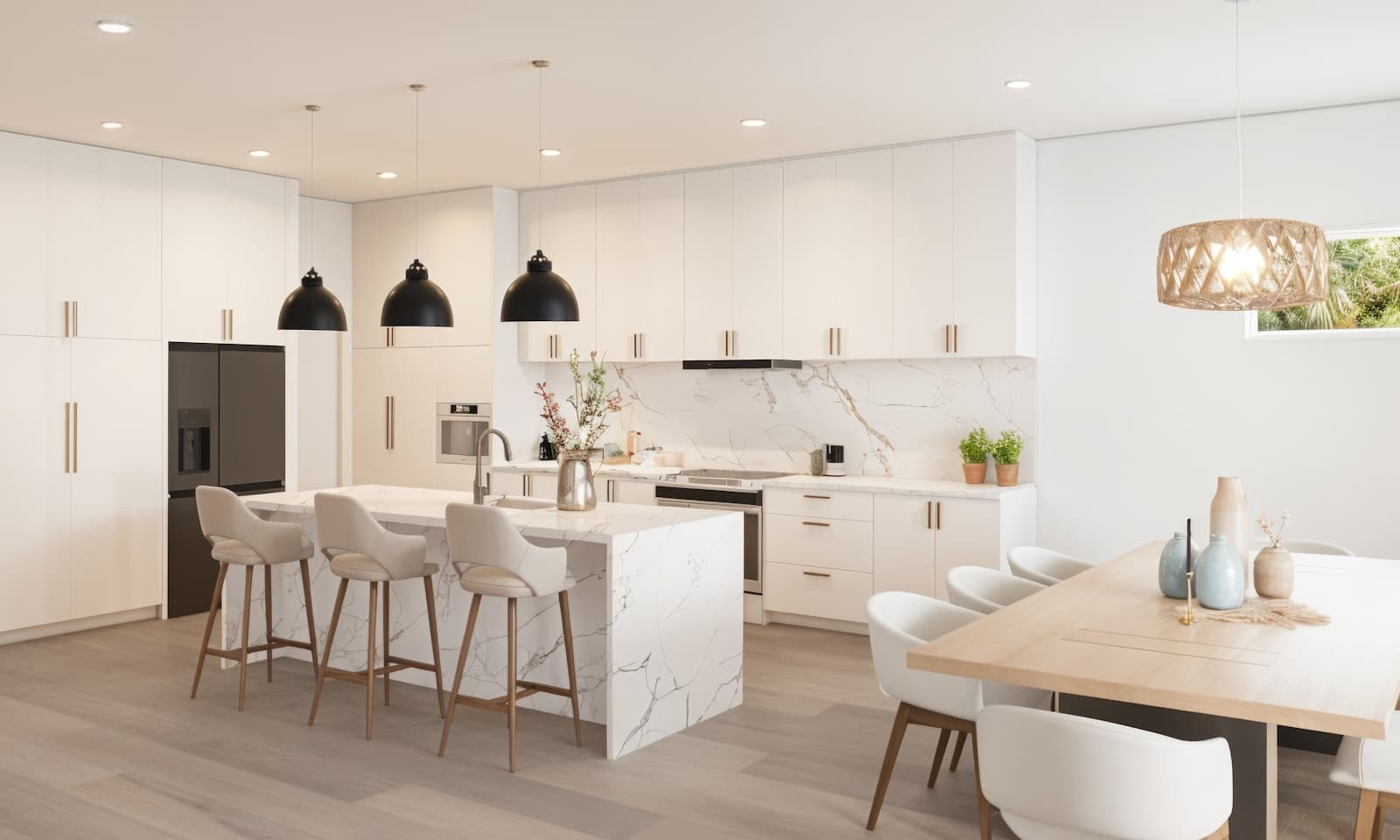
- Waterfall — slab continues vertically down the side of an island (premium)
Fabrication note: Quartz is slightly easier to fabricate consistently due to its uniform composition. Granite requires more skill to match patterns at seams and manage the natural variations in the stone.
Which Should You Choose?#
Choose Quartz If:#
- You want zero maintenance — no sealing, no special cleaning
- You prefer a consistent, controlled look
- You love the marble aesthetic but not the marble maintenance
- You have young children or a busy household
- You want a modern or transitional kitchen design
- Your kitchen is the main work surface and takes heavy daily use
Choose Granite If:#
- You want a completely unique surface that no one else has
- You cook frequently and need direct heat resistance
- You prefer the character and depth of natural stone
- You are building an outdoor kitchen
- You have a traditional or classic NJ home (colonial, Tudor, craftsman)
- You enjoy maintaining your home and do not mind the annual sealing ritual
Choose Both If:#
Many NJ homeowners use quartz for the perimeter counters (where most of the daily cooking and cleaning happens) and granite for the island (where the natural beauty makes a statement). This combination gives you low maintenance where it matters most and natural character where it shows most.
What About Quartzite?#
A common source of confusion: quartzite is not the same as quartz.
- Quartz = engineered stone (ground quartz + resin)
- Quartzite = natural stone (metamorphic rock, harder than granite)
Quartzite offers many of granite's benefits (natural beauty, heat resistance, uniqueness) with better stain resistance. It typically costs $80 to $150 per square foot installed in NJ. If you want the look of marble with granite-level durability, quartzite is worth considering.
Getting the Best Price in NJ#
Buying Tips#
- 1Visit stone yards, not just showrooms. NJ has several stone fabricators in the Trenton, Edison, and North Jersey industrial corridors. Buying directly from a fabricator-installer saves 15 to 25% compared to big-box store pricing.
- 1Buy remnants for small projects. If you only need a bathroom vanity top or a small bar counter, stone yards sell leftover slab pieces at 40 to 60% off. Call ahead — remnant inventory changes weekly.
- 1Get three quotes minimum. Pricing for the same material varies significantly between NJ fabricators. We have seen $20 per square foot differences for identical Caesarstone colors.
- 1Time your project. Late fall through early spring is slower for NJ countertop fabricators. You may get better pricing and faster turnaround during the off-season.
- 1Ask about package pricing. If you are doing a full kitchen remodel, your general contractor's fabricator relationship often delivers better countertop pricing than sourcing independently.
Installation: What to Expect#
Regardless of material choice, professional installation in NJ follows the same process:
- 1Template — a fabricator visits your home after cabinets are installed and creates a precise template of your countertop layout using laser measurement or physical templates
- 1Fabrication — the slab is cut, polished, and edge-profiled at the fabrication shop (typically 5 to 10 business days)
- 1Installation — installers deliver and set the slabs, typically completing the work in 2 to 4 hours for a standard kitchen. Sinks, cooktops, and faucets are cut out during fabrication.
- 1Sealing (granite only) — the first seal is applied after installation. This initial seal is usually included in the installation price.
NJ permit note: Countertop replacement alone does not require a building permit in New Jersey. However, if your remodel includes plumbing relocation, electrical work, or structural changes, those elements require permits through your local construction office.
Our Recommendation#
For most NJ kitchens in 2026, quartz is the stronger choice. The zero-maintenance advantage, consistent appearance, humidity resistance, and modern aesthetic align with how NJ homeowners actually use their kitchens. It is the material we install most frequently, and the material that generates the fewest callbacks or issues.
Granite remains an excellent choice for homeowners who value natural stone character, need direct heat resistance, or want an outdoor kitchen surface. It has earned its reputation over decades and shows no signs of falling out of favor in NJ's premium housing market.
The wrong choice is neither quartz nor granite — the wrong choice is laminate in a kitchen where you are investing in premium cabinets, appliances, and finishes. Both quartz and granite deliver the durability, beauty, and resale value that justify their cost.
Ready to Compare Materials in Person?#
The best way to choose between quartz and granite is to see them side by side in your actual kitchen. We bring samples to your home so you can compare materials against your cabinets, backsplash, and lighting — the showroom never matches real conditions.
Learn more about our full kitchen remodeling services, including countertop selection and installation. For a broader comparison that includes marble, butcher block, laminate, and concrete, see our complete countertop materials guide. For a full breakdown of kitchen remodel costs in NJ, check our kitchen remodel cost guide.
At The5thwall, we provide free consultations for kitchen remodels across Central NJ — Lawrence, Princeton, Hamilton, Ewing, West Windsor, Hopewell, Pennington, Robbinsville, and Lawrenceville. Call us at (609) 954-3659 or fill out our contact form to schedule a visit.
Written by
Tony Karpontinis
Published April 7, 2026 · 15 min read
The5thwall is a father-and-son licensed NJ contractor based in Mercer County. Beyond the Blueprint is our journal — field-tested insights from two decades of renovation work across Central New Jersey.