In this article
- Princeton Kitchens Demand a Different Approach
- Princeton's Home Styles and What They Mean for Kitchens
- Pre-War Colonials and Tudors (1900-1940)
- Mid-Century Ranches and Split-Levels (1950-1970)
- Newer Construction and Additions (1980-2010)
- The Princeton Historic District Factor
- Princeton Kitchen Design Trends in 2026
- Princeton Kitchen Remodel Costs in 2026
- Budget Refresh: $20,000 - $35,000
- Mid-Range Full Remodel: $45,000 - $80,000
- High-End Custom Remodel: $80,000 - $150,000+
- The Princeton Permit Process
- Common Mistakes in Princeton Kitchen Remodels
- Why Princeton Homeowners Choose The5thwall
- Related Resources
Princeton Kitchens Demand a Different Approach#
Princeton is not a typical New Jersey suburb. The homes are older, the architectural standards are higher, the expectations are refined, and many properties sit within or adjacent to the Princeton Historic District. A kitchen remodel in Princeton is not just a renovation — it is a careful balance between modernizing a space for how families live today while respecting the character that makes Princeton homes valuable.
Whether you own a 1920s colonial on Mercer Street, a mid-century ranch near the university, or a stately Tudor in the Western Section, this guide covers what Princeton homeowners need to know before remodeling a kitchen.
Planning a Princeton kitchen remodel? [Get a free estimate](/contact) — we understand what these homes need.
Princeton's Home Styles and What They Mean for Kitchens#
Pre-War Colonials and Tudors (1900-1940)#
The quintessential Princeton homes — brick or stone exteriors, formal room layouts, hardwood floors, plaster walls, and original details like crown molding, wainscoting, and butler's pantries.
Kitchen remodeling considerations: - Original kitchen layouts are typically small, enclosed rooms separated from dining and living areas by walls — many of which are load-bearing - Plaster walls require specialized repair techniques different from standard drywall - Older electrical systems (sometimes still knob-and-tube in sections) often need full rewiring to support modern kitchen loads - Original hardwood floors may extend under kitchen flooring and can be salvaged and refinished - Built-in cabinetry and trim details should be preserved or matched when possible — these add value - Asbestos insulation and lead paint are common in homes of this era and require professional remediation before demolition
Design direction: Princeton colonial kitchens work best when they honor the home's formal proportions. Shaker-style cabinetry with frame detail, marble or soapstone countertops, unlacquered brass hardware, and integrated appliances that disappear into the millwork. The goal is a kitchen that feels like it has always belonged in the home — not a modern box dropped into a historic shell.
Mid-Century Ranches and Split-Levels (1950-1970)#
These homes often feature open or semi-open kitchen layouts, lower ceiling heights, and simpler construction. They are excellent candidates for renovation because the structures are straightforward and the layouts can be significantly improved.
Kitchen remodeling considerations: - Galvanized plumbing is common and should be replaced during a renovation - Electrical panels are often undersized (60-100 amp) for modern kitchen demands - Ceiling heights of 8 feet limit some design choices but work well with contemporary flush-mount lighting - Original linoleum or vinyl flooring may contain asbestos — test before removal
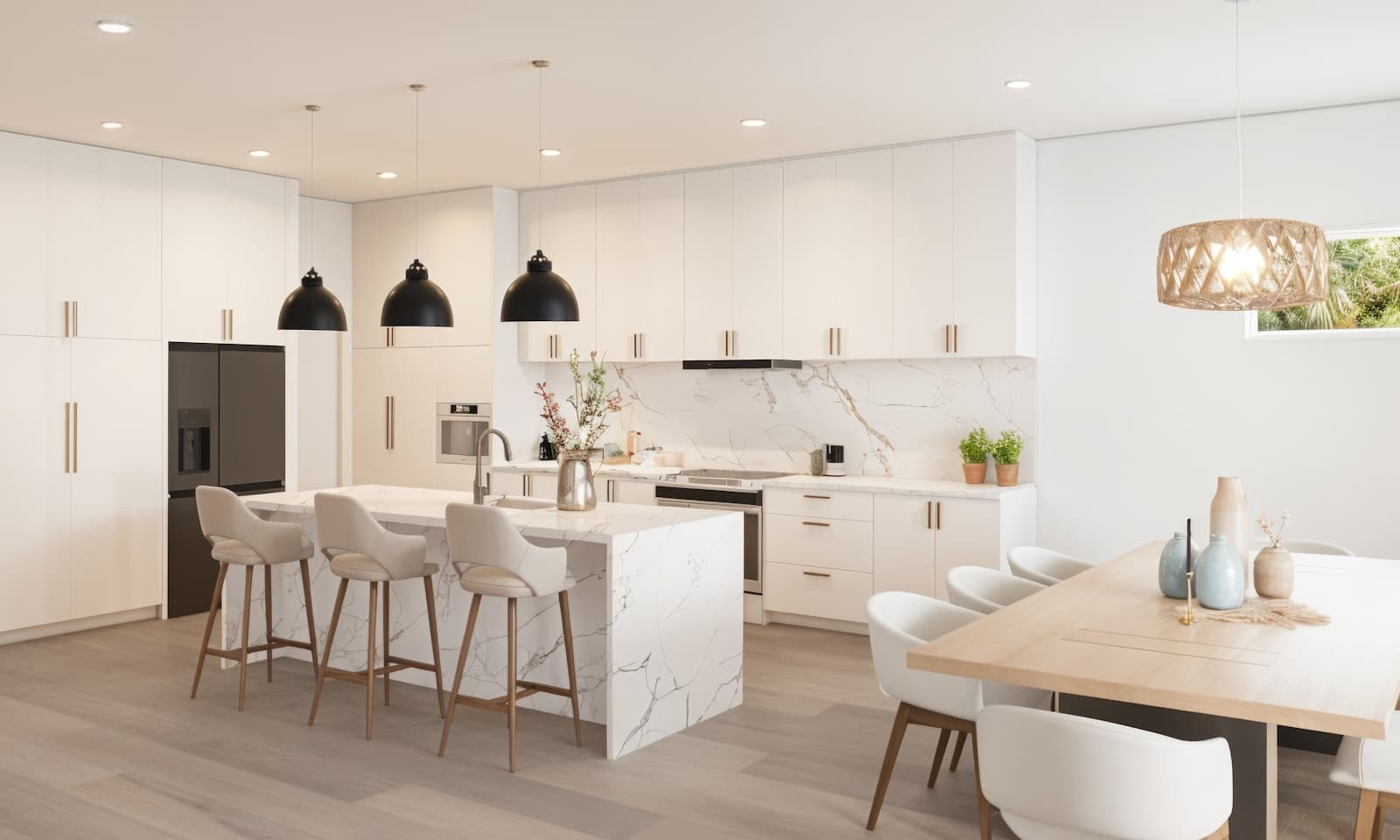
Design direction: Mid-century Princeton homes respond well to clean, modern kitchens — flat-panel cabinetry, waterfall-edge quartz islands, integrated lighting, and open shelving. The simpler architecture allows bolder design choices.
Newer Construction and Additions (1980-2010)#
Some Princeton properties feature additions or newer sections that may need updating from builder-grade finishes to premium materials. These are typically the most straightforward kitchen remodels because the infrastructure is modern.
[Tell us about your Princeton home](/contact) — we will assess what your kitchen needs.
The Princeton Historic District Factor#
Princeton's Historic District encompasses much of the downtown and surrounding neighborhoods. If your property falls within the district boundaries, exterior modifications require review by the Princeton Historic Preservation Commission (HPC).
What this means for kitchen remodels:
- Interior renovations generally do not require HPC approval — you can remodel your kitchen freely
- If your kitchen remodel involves exterior changes (new windows, exterior venting, additions), HPC review is required
- Window replacements visible from the street may need to match the original style and material
- Additions that expand the kitchen footprint must be architecturally compatible with the existing structure
What does NOT require HPC review: Interior layout changes, cabinetry, countertops, flooring, appliances, lighting, plumbing fixtures — essentially the entire interior kitchen remodel.
The practical impact: most Princeton kitchen remodels are interior-only and proceed through standard Mercer County building permits without HPC involvement. We confirm this for every Princeton project during the estimate visit.
Princeton Kitchen Design Trends in 2026#
Here is what Princeton homeowners are actually requesting — not magazine trends, but what we see in real projects across the borough:
Preserving character while upgrading function. The dominant theme in Princeton kitchen design is "update everything behind the scenes, keep everything that makes the home special." Modern appliances, efficient lighting, and proper ventilation — hidden behind cabinetry and finishes that complement the home's era.
Open concept with structural integrity. Many Princeton colonial homeowners want to open the kitchen to adjacent dining or living spaces. This requires structural engineering — a properly sized header beam to carry the load where the wall was removed. In Princeton homes with plaster, brick, or stone, this demands experience with older construction methods. We handle the structural engineering, permitting, and execution as part of the project.
Soapstone and marble countertops. While quartz dominates the general NJ market, Princeton homeowners skew toward natural stone — especially soapstone and honed marble — for their character and historic compatibility. Soapstone develops a rich patina over time. Honed Carrara marble, while requiring more maintenance, suits the aesthetic of a 1920s Princeton colonial perfectly.
Custom cabinetry over semi-custom. Princeton kitchens frequently require custom cabinetry because the rooms are not standard dimensions. Uneven walls, non-square corners, and ceiling height variations in older homes mean stock or even semi-custom cabinets leave gaps and look wrong. Custom cabinetry, built to the exact dimensions of the space, is the standard here.
Professional-grade appliances. Sub-Zero, Wolf, Thermador, and Miele are common in Princeton kitchen remodels. The investment in premium appliances reflects both the lifestyle and the home values in this market.
Warm, sophisticated palettes. Princeton kitchens trend toward warm whites, creamy off-whites, sage greens, and navy — paired with natural wood tones, brass or bronze hardware, and natural stone. The all-white kitchen trend has faded in favor of warmer, more layered spaces.
[Ready to design your Princeton kitchen? Get a free consultation](/contact).
Princeton Kitchen Remodel Costs in 2026#
Princeton kitchen remodels run at the higher end of the Central NJ market due to the complexity of older homes, the expectation of premium materials, and the craftsmanship required to work within historic structures.
Budget Refresh: $20,000 - $35,000 New countertops over existing cabinets, backsplash, hardware, fixtures, lighting, and paint. Works well for Princeton homes where the layout is functional but the finishes are dated.#
Mid-Range Full Remodel: $45,000 - $80,000 New cabinetry (semi-custom or custom), quartz or natural stone countertops, full backsplash, new flooring, complete lighting redesign, plumbing fixtures, and appliance package. This is the most common Princeton kitchen remodel tier.#
High-End Custom Remodel: $80,000 - $150,000+ Custom cabinetry, natural stone countertops, open-concept wall removal with structural engineering, plumbing relocation, full electrical rewiring, professional-grade appliances, custom lighting, and premium finishes throughout. For Princeton homes where the kitchen is being completely reimagined.#
These ranges include all permits, inspections, and cleanup. Princeton permit processing through Mercer County typically takes 2-3 weeks.
[Get your exact number — request a free Princeton kitchen estimate](/contact).
The Princeton Permit Process#
Kitchen remodels in Princeton follow Mercer County building permit requirements:
- Plumbing changes — moving the sink, dishwasher, or gas line requires a plumbing permit
- Electrical work — adding circuits, moving outlets, panel upgrades require an electrical permit
- Structural modifications — wall removal requires a building permit with structural engineering plans
- Gas work — new gas range or cooktop requires a gas permit
What does NOT typically require a permit: Cabinet replacement in the same location, countertop replacement, backsplash, painting, hardware, and swapping a faucet on existing plumbing.
Princeton's building department is thorough. Inspectors expect work to meet code exactly, and they know what quality construction looks like. We welcome that — it protects you and validates our work.
For more detail on NJ permits, see our complete permits guide.
Common Mistakes in Princeton Kitchen Remodels#
1. Treating it like a suburban kitchen remodel. Princeton homes have specific construction characteristics — plaster walls, older framing, unique dimensions — that generic renovation approaches handle poorly. Every Princeton kitchen needs a site-specific assessment.
2. Ignoring the home's architectural context. A stark modern kitchen in a 1920s colonial creates a jarring disconnect that hurts both livability and resale value. The best Princeton kitchen remodels are designed to complement the home's era and character.
3. Underestimating electrical upgrades. Many Princeton homes have 100-amp or even 60-amp electrical panels. A modern kitchen with professional-grade appliances can draw 60+ amps alone. Panel upgrades are frequently necessary and should be budgeted from the start.
4. Choosing the cheapest bid. Princeton homes require contractors with experience in older construction. A low bid from a contractor unfamiliar with plaster, load-bearing masonry, or historic renovation techniques leads to damage, delays, and cost overruns.
5. Not planning for asbestos and lead. Pre-1978 Princeton homes commonly contain lead paint and asbestos in flooring, insulation, or pipe wrap. Professional testing and remediation must happen before demolition begins. Budget $2,000-$5,000 for testing and remediation.
Why Princeton Homeowners Choose The5thwall#
We understand Princeton. Tony brings over 20 years of experience with older NJ homes — the plaster, the wiring, the structural nuances. Stefanos translates your vision into a buildable plan that respects your home's character while delivering the modern kitchen you want.
As a father-and-son team based in Lawrence — just minutes from Princeton — we are your neighbors, not a distant franchise. Every Princeton project gets personal attention from the owners, not a rotating crew of strangers.
- NJ Licensed Home Improvement Contractor — registered, insured ($2M liability), compliant
- 20+ years of experience with Central NJ homes including pre-war construction
- We handle everything — design, permits, structural engineering coordination, construction, inspections, cleanup
- Free, no-obligation estimates — detailed and honest, delivered within a week of the visit
[Schedule your free Princeton kitchen consultation](/contact) — or call us directly at (609) 954-3659.
Related Resources#
- Kitchen Remodeling Services — full details on our kitchen remodeling capabilities
- Kitchen Remodeling in NJ: Cost, Timeline & What to Expect — comprehensive NJ-wide guide
- Kitchen Remodel Cost in NJ (2026) — detailed cost breakdown by tier
- Home Renovation in Princeton NJ — full Princeton renovation guide
- How to Choose a General Contractor in NJ — vetting and hiring guide
- NJ Renovation Permits Guide — permit requirements by project type
Your Princeton kitchen deserves a contractor who understands these homes. [Get your free estimate today](/contact) or call (609) 954-3659.
Written by
The5thwall
Published April 7, 2026 · 12 min read
The5thwall is a father-and-son licensed NJ contractor based in Mercer County. Beyond the Blueprint is our journal — field-tested insights from two decades of renovation work across Central New Jersey.