In this article
- Most NJ Bathrooms Are Small — That Does Not Mean They Have to Feel Small
- Understanding NJ Small Bathroom Layouts
- The 5x7 Full Bath
- The 5x8 Full Bath
- The Powder Room (3x5 to 4x6)
- The Tub-to-Shower Conversion: The Single Biggest Impact
- Walk-In Shower Options for Small NJ Bathrooms
- Space-Saving Fixtures
- Vanities
- Toilets
- Sinks
- Tile Strategies That Make Small Bathrooms Feel Bigger
- Large-Format Tiles
- Light-Colored Tiles
- Continuous Floor-to-Ceiling Tile
- The Vertical Stack
- The Shower Accent Wall
- Storage Solutions for Small NJ Bathrooms
- Recessed Storage
- Vertical Storage
- Built-In Storage
- Hidden Storage
- Lighting Strategies
- Layer Your Lighting
- Natural Light Strategies
- Color and Material Strategies
- The Monochromatic Approach
- The White-Plus-One Strategy
- Materials That Work in Small Spaces
- Small Bathroom Remodel Cost Guide (NJ 2026)
- Common Mistakes to Avoid
Most NJ Bathrooms Are Small — That Does Not Mean They Have to Feel Small#
The typical bathroom in a Central NJ home — especially in Colonials, Cape Cods, ranches, and split-levels built between 1950 and 1990 — measures 5x7 or 5x8 feet. That is 35 to 40 square feet. A standard builder-grade bathroom crammed with a 5-foot tub, a pedestal sink, and a 30-inch vanity in a room with one window and one overhead light.
These bathrooms were designed for a different era. They are functional but they are not comfortable, not efficient, and not attractive. The good news: a small bathroom remodel in NJ does not require knocking out walls or stealing closet space. The right fixture choices, tile strategies, storage solutions, and lighting can transform a cramped 5x7 bathroom into a room that feels open, modern, and efficient — without changing the footprint.
This guide covers every strategy, product choice, and design idea for maximizing a small NJ bathroom within its existing walls.
Understanding NJ Small Bathroom Layouts#
The 5x7 Full Bath#
The most common small bathroom in NJ. 35 square feet. Typically contains: - 5-foot alcove bathtub with shower - 30-inch vanity with sink - Standard toilet - One window (usually above the tub)
The 5x7 constraint: With a 5-foot tub on one wall and a toilet and vanity on the opposite wall, you have approximately 24-30 inches of clear floor space between them. This is the minimum code-compliant clearance, and it feels tight. Every fixture decision in a 5x7 bathroom is a zero-sum trade — making one thing bigger means making something else smaller.
The 5x8 Full Bath#
40 square feet. The extra foot of length provides meaningfully more flexibility: - Room for a 36-inch vanity instead of 30-inch - Space for a linen tower or built-in cabinet - Slightly more comfortable clearance between fixtures
The Powder Room (3x5 to 4x6)#
15 to 24 square feet. Half bath with sink and toilet only. The constraints are even tighter, but the solutions are more focused — no tub or shower to work around.
The Tub-to-Shower Conversion: The Single Biggest Impact#
Removing the bathtub and replacing it with a walk-in shower is the single most impactful change in a small NJ bathroom remodel. Here is why:
What a tub takes: A standard 5-foot alcove tub with shower curtain occupies 15 square feet of floor space and makes the room feel enclosed because the tub walls and curtain create a visual barrier.
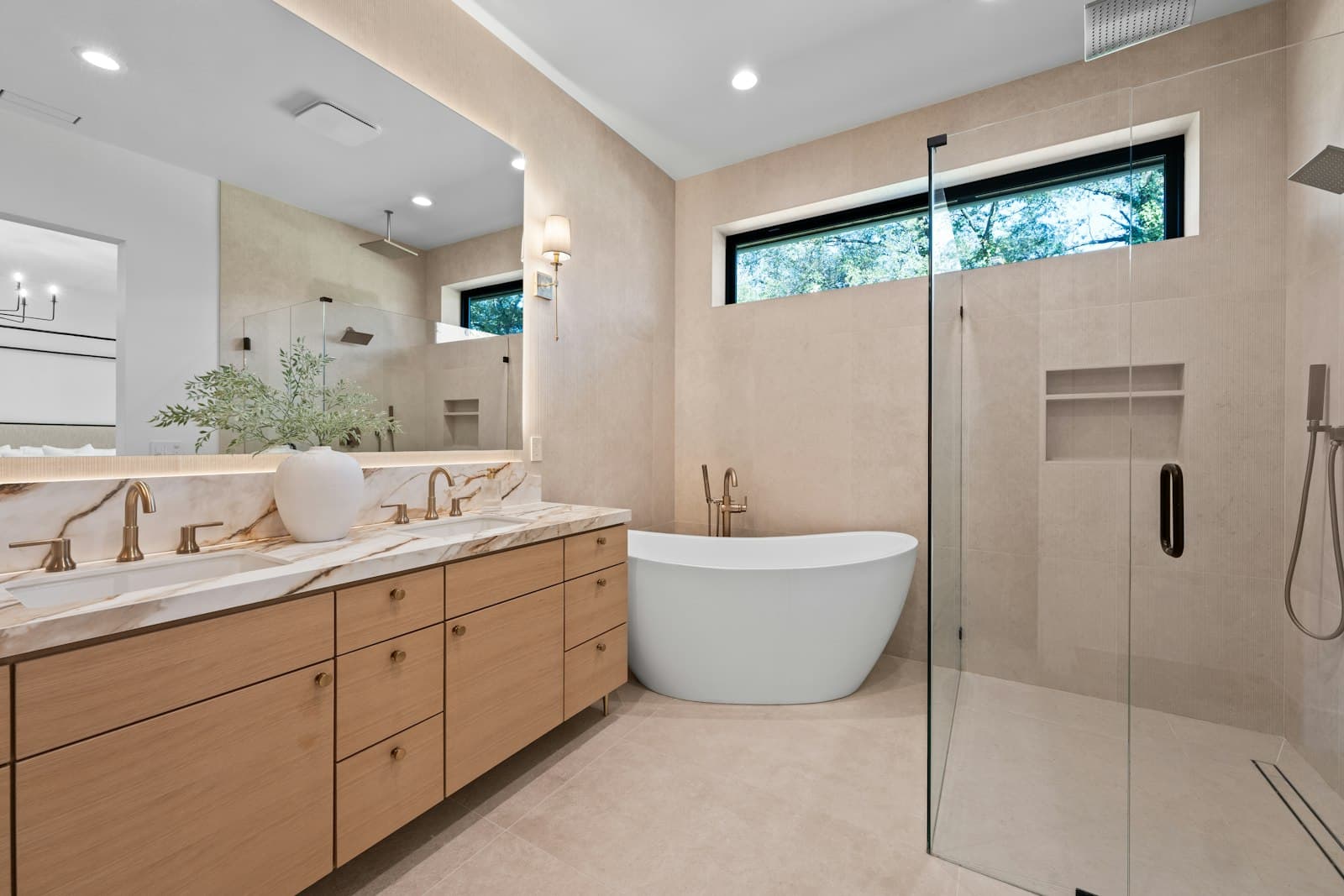
What a walk-in shower gives back: A walk-in shower with a frameless glass panel (no shower curtain, no opaque door) opens the visual field. The glass panel allows the eye to travel through the entire room without interruption. The shower floor becomes part of the bathroom floor visually, making the room feel larger.
Walk-In Shower Options for Small NJ Bathrooms#
Curbless (zero-threshold) shower: The shower floor is flush with the bathroom floor — no curb or step to trip over. The entire bathroom floor slopes slightly toward the drain. This is the most open-feeling option and the best for accessibility and aging-in-place.
Cost: $4,000-$8,000 for demo, waterproofing, and tile installation as of 2026 NJ code note: Curbless showers require a waterproof membrane (Schluter Kerdi, Laticrete Hydro Ban, or equivalent) across the entire bathroom floor, not just the shower area. The floor must be pitched correctly to prevent water from pooling outside the shower zone.
Low-profile curb shower: A 2-3 inch curb at the shower entry rather than the standard 4-5 inch curb. Provides water containment with a lower step-over height. Combined with a frameless glass panel, this is almost as open-feeling as curbless.
Cost: $3,000-$6,000 as of 2026
Shower pan with glass enclosure: A pre-fabricated shower pan (acrylic or solid surface) with a frameless glass enclosure. The most affordable walk-in option that still provides the open visual effect.
Cost: $2,500-$5,000 as of 2026
When to keep the tub: If the bathroom is the only bathroom with a tub in the house, removing it may reduce resale value — families with young children expect at least one tub. In this case, consider a freestanding soaking tub (if the bathroom is 5x8 or larger) or a tub-shower combo with a frameless glass panel instead of a shower curtain.
Space-Saving Fixtures#
Vanities#
The vanity is the second-largest fixture in a small bathroom. Choosing the right size and style makes a measurable difference.
Wall-mounted (floating) vanity: A vanity that mounts to the wall with no legs or base touching the floor. The visible floor space underneath makes the room feel larger. Available in 24-inch, 30-inch, and 36-inch widths.
Best for 5x7: 24-inch or 30-inch wall-mounted vanity Best for 5x8: 30-inch or 36-inch wall-mounted vanity Cost: $400-$2,000 for the vanity plus $200-$500 for installation as of 2026
Corner vanity: A vanity designed to fit in a corner, freeing the walls for other fixtures. 20-24 inch footprint. Limited storage but maximizes open floor space.
Console vanity (open shelf): A vanity with legs and open shelving instead of closed cabinets. The open design makes the room feel less crowded. Add baskets or bins on the open shelves for concealed storage.
Vanity with integrated sink: The sink basin is formed into the countertop material — no separate bowl sitting on or in the counter. This creates a smooth, continuous surface that is easier to clean and feels less cluttered in a small space.
Toilets#
Compact elongated toilet: Modern compact elongated bowls provide the comfort of an elongated seat in the footprint of a round bowl. The bowl extends 25-27 inches from the wall instead of 28-30 inches. Those 2-3 inches matter in a 5x7 bathroom.
Wall-hung toilet: The tank is concealed inside the wall (a carrier frame installed during rough-in), and the bowl is mounted to the wall with no base touching the floor. Like a wall-mounted vanity, the visible floor space underneath makes the room feel larger. The toilet projects 21-22 inches from the wall — the shortest projection available.
Cost: $800-$2,500 for the toilet plus carrier frame, plus $500-$1,000 for installation (the wall must be opened for the carrier frame) as of 2026
Skirted (concealed trapway) toilet: A standard floor-mounted toilet with a smooth exterior that conceals the trapway (the S-shaped pipe at the base). No visible bolts or curves to collect dust. Cleaner appearance in a small space. $300-$800 as of 2026.
Sinks#
Vessel sink: A bowl-shaped sink that sits on top of the counter. Takes up less counter depth and allows a narrower vanity. Modern aesthetic.
Undermount sink: Mounted under the countertop surface. Creates a clean, continuous counter edge and makes the counter feel larger because there is no rim taking up space.
Wall-mounted sink: No vanity at all — the sink mounts directly to the wall. Maximum floor space, minimum storage. Best for powder rooms where storage is not needed.
Tile Strategies That Make Small Bathrooms Feel Bigger#
Tile selection is one of the most powerful tools for manipulating the perceived size of a small bathroom.
Large-Format Tiles#
The rule: Fewer grout lines = larger perceived space. A 12x24 tile on the floor of a 5x7 bathroom requires a fraction of the grout lines that a 4x4 tile requires. The continuous surface makes the floor feel expansive.
Recommended floor tile sizes for small NJ bathrooms: 12x24, 12x12, or 8x8 minimum. Avoid anything smaller than 6x6 on the floor.
On the walls: Carry the floor tile up the walls (especially in the shower) for a continuous visual flow. Large-format wall tile (12x24 or larger) in a horizontal orientation makes the room feel wider.
Light-Colored Tiles#
Light colors reflect more light and make surfaces recede visually. In a small NJ bathroom with limited natural light (many NJ bathrooms have one small window or no window), light tile is transformative.
Best colors for small bathrooms: White, off-white, light grey, soft greige, pale blue-grey. Avoid dark grout with light tile in small spaces — the grid of dark lines breaks up the visual continuity.
Continuous Floor-to-Ceiling Tile#
Tiling the shower walls from floor to ceiling (rather than stopping at a tile wainscot line) draws the eye upward and makes the ceiling feel higher. This also eliminates the visual break that a paint-to-tile transition creates.
Cost impact: Full floor-to-ceiling shower tile adds $500-$1,500 compared to a standard wainscot height installation, depending on the tile selected. The visual payoff in a small bathroom is worth the investment.
The Vertical Stack#
Running rectangular tiles (such as 4x12 subway tiles) in a vertical orientation instead of the traditional horizontal running bond pattern draws the eye upward and makes the ceiling feel higher. This is a free design upgrade — same tile, same cost, bigger visual impact.
The Shower Accent Wall#
One wall of the shower in a contrasting tile (mosaic, different color, or different format) creates a focal point that draws the eye to a specific area. A single accent wall is more effective in a small bathroom than multiple tile patterns, which can make the room feel busy and smaller.
Storage Solutions for Small NJ Bathrooms#
Storage is the biggest challenge in a small bathroom. NJ bathrooms from the 1960s-1980s typically have a single medicine cabinet and a vanity with two doors — barely enough for essentials.
Recessed Storage#
Medicine cabinet (recessed): A recessed medicine cabinet sits inside the wall cavity rather than projecting into the room. Standard wall depth (3.5 inches between studs) accommodates most toiletries. Choose a cabinet with a mirror front to serve double duty.
Recessed niche in the shower: A tiled niche built into the shower wall provides shampoo and soap storage without a hanging caddy or shelf projecting into the shower space. Standard size: 12x24 inches. Place it at chest height for easy access. Cost: $200-$500 as part of a tile shower installation.
Recessed toilet paper holder: Sits flush with the wall instead of projecting 4+ inches into the room.
Vertical Storage#
Over-toilet shelving or cabinet: The wall space above the toilet is almost always unused. A slim cabinet (8-12 inches deep) or floating shelves turn dead space into storage.
Tall linen tower: A narrow (12-15 inch wide), floor-to-ceiling cabinet provides substantial storage in a footprint that barely impacts floor space. Position in a corner or beside the vanity.
Towel bar stack: Instead of one towel bar, install two or three bars vertically on one wall. Each bar holds a towel; the vertical arrangement uses less wall space than horizontal bars.
Built-In Storage#
Knee wall shelving: In bathrooms adjacent to an attic or under-stair space, recessed shelving can be built into the knee wall for deep storage that does not encroach on the bathroom floor area.
Built-in vanity pullouts: Retrofit the existing vanity with pull-out drawer inserts that organize the interior space. A 30-inch vanity with two pull-out trays holds more accessible items than the same vanity with a single shelf.
Hidden Storage#
Mirror with hidden shelf: Mirrors that open to reveal a slim shelf behind them provide concealed storage without the visual weight of a cabinet.
Vanity drawer organizers: Divided drawer inserts (bamboo, acrylic, or custom-fitted) maximize every inch inside vanity drawers. The difference between an organized and unorganized small vanity is the difference between feeling like you have enough storage and feeling like you need a bigger bathroom.
Lighting Strategies#
Good lighting makes a small bathroom feel significantly more open. Bad lighting makes it feel like a closet.
Layer Your Lighting#
Vanity lighting: Wall-mounted sconces on either side of the mirror at face height (approximately 66 inches from floor to center) provide even, shadow-free light for grooming. Side-mounted sconces are better than overhead strip lights in small bathrooms because they illuminate the face evenly rather than creating shadows under the brow and nose.
Overhead/ambient lighting: A recessed light (4-inch or 6-inch) centered in the room provides general illumination. In a small bathroom, one to two recessed lights are sufficient. Avoid large flush-mount fixtures that hang down and make the ceiling feel lower.
Shower light: A dedicated waterproof recessed light in the shower ceiling eliminates the dark cave feeling when the shower curtain or glass is closed. NJ electrical code requires shower lights to be rated for wet locations (IC-rated for insulated ceilings).
Accent/night lighting: LED strip lighting under a floating vanity or behind a mirror creates ambient glow for middle-of-the-night use without blinding overhead light. Adds a modern, spa-like quality.
Natural Light Strategies#
Frosted glass window: If the bathroom has a window, replace clear glass with frosted for privacy while maintaining natural light.
Tubular skylight (sun tunnel): For interior NJ bathrooms with no window, a tubular skylight routes natural light from the roof through a reflective tube to a ceiling fixture. No structural changes to the roof framing — just a 10-14 inch penetration. $500-$1,500 installed as of 2026.
Transom window: A narrow horizontal window above the bathroom door borrows light from the hallway without sacrificing privacy. Works well in NJ homes with interior hallway bathrooms.
Color and Material Strategies#
The Monochromatic Approach#
Using one color family throughout the bathroom — walls, floor, vanity, fixtures — creates visual continuity that makes the room feel larger. Vary the tone (lighter on walls, slightly darker on floors) rather than introducing multiple colors.
The White-Plus-One Strategy#
White walls, white tile, white vanity — with one warm material as the accent. A wood-tone vanity front, brass hardware, or a natural stone countertop provides warmth and personality without visual clutter. This is the most reliable approach for small NJ bathrooms.
Materials That Work in Small Spaces#
- Porcelain tile in large format (12x24 or larger) for floors and walls
- Quartz countertop (easy to clean, consistent color, no sealing required)
- Frameless glass for shower enclosures (avoid framed enclosures — the metal frames break up the visual space)
- Brushed nickel or matte black hardware (consistent finish throughout — do not mix metals in a small space)
- Semi-gloss or satin paint on walls and ceiling (reflects light better than flat/matte)
Small Bathroom Remodel Cost Guide (NJ 2026)#
| Scope | 5x7 Bathroom | 5x8 Bathroom |
|---|---|---|
| Cosmetic refresh (paint, hardware, light fixtures, mirror) | $2,000-$5,000 | $2,000-$5,000 |
| Mid-range remodel (new vanity, toilet, tile, lighting, paint) | $10,000-$18,000 | $12,000-$20,000 |
| Full remodel (demo to studs, new everything, shower conversion) | $18,000-$30,000 | $20,000-$35,000 |
| Full remodel with layout change (moving plumbing) | $25,000-$40,000 | $28,000-$45,000 |
Cost drivers in small NJ bathrooms: - Tile labor is the same per square foot whether the bathroom is 35 sq ft or 100 sq ft — and cutting tile around tight corners, fixtures, and niches in a small bathroom actually takes longer per square foot than in a large one - Plumbing moves ($1,500-$5,000 per fixture moved) are the biggest cost escalator - Waterproofing for a curbless shower adds $500-$1,500 to the project but is essential for NJ building code compliance - Ventilation — NJ code requires an exhaust fan in every bathroom. A quality fan (HVI-certified, 80-110 CFM) with a quiet sone rating costs $150-$400 plus installation. This is not optional and should not be skipped in a small bathroom where moisture control is critical.
Common Mistakes to Avoid#
1. Choosing fixtures that are too large. A 48-inch double vanity does not fit in a 5x7 bathroom. A standard elongated toilet projects too far. Measure twice, order once.
2. Using small tiles on the floor. Penny tile and 2x2 mosaic tile on the floor of a small bathroom creates a busy grid of grout lines that makes the room feel smaller. Save mosaic tile for the shower niche accent.
3. Dark tile everywhere. Dark tile absorbs light and makes walls feel closer. Reserve dark tile for accents — one shower wall or the floor — and keep the majority of surfaces light.
4. Skipping the exhaust fan upgrade. Many older NJ bathrooms have weak or non-functional exhaust fans. In a small bathroom with a shower, proper ventilation prevents mold, protects finishes, and extends the life of every surface in the room.
5. Ignoring the door swing. In a 5x7 bathroom, an inward-swinging door can hit the vanity or toilet. A pocket door, barn door, or outward-swinging door recovers 5-7 square feet of usable floor space.
6. No storage plan. A beautiful remodel without adequate storage means toiletries on the counter, bottles on the shower floor, and towels on the door hook. Plan storage into the design from the start.
We handle small bathroom remodels across Central NJ — from cosmetic refreshes to full gut renovations with shower conversions. Over 20 years of combined experience. NJ HIC registered. Call (609) 954-3659 for a free estimate.
Learn more about our bathroom remodeling services and what each level of renovation includes. Our bathroom remodel cost guide breaks down pricing in detail. For vanity-specific inspiration, see our bathroom vanity ideas guide. And if you are weighing bathroom vs. kitchen, our kitchen vs. bathroom remodel guide helps you decide which to tackle first.
Written by
The5thwall
Published April 7, 2026 · 14 min read
The5thwall is a father-and-son licensed NJ contractor based in Mercer County. Beyond the Blueprint is our journal — field-tested insights from two decades of renovation work across Central New Jersey.